
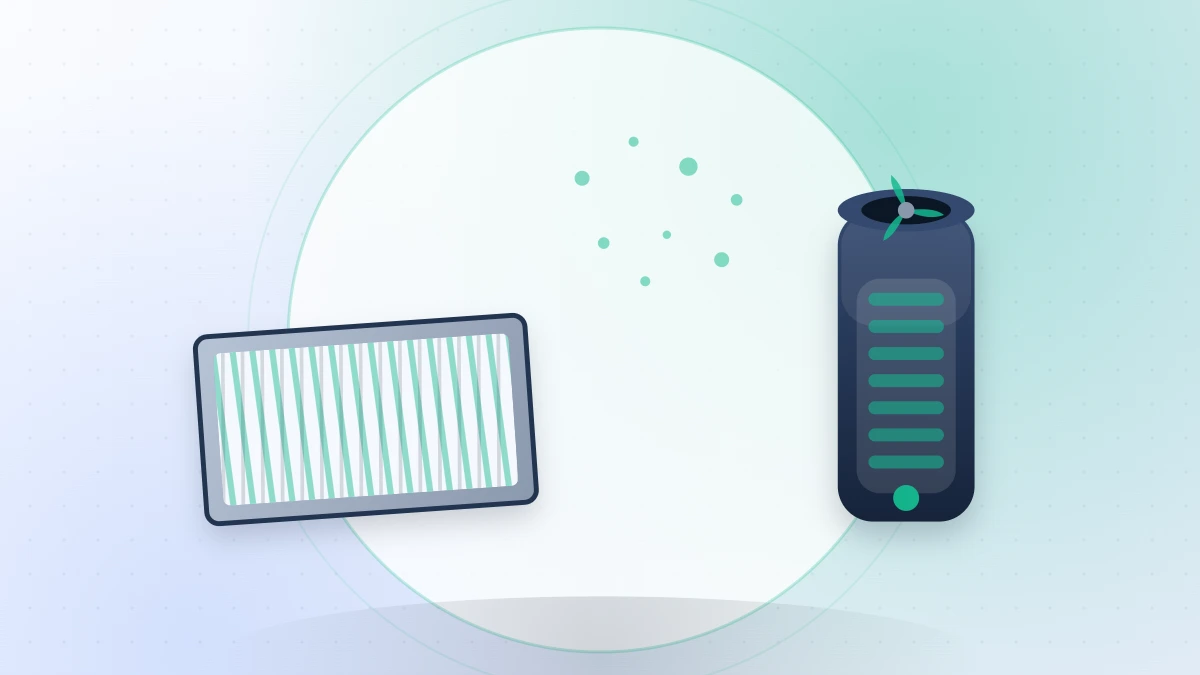
These two products are sold to solve the same problem and work in completely different ways. Choosing well starts with being specific about what is actually wrong with the air in your car.
How your car already cleans air
Air entering the cabin through the ventilation system passes through a cabin air filter, usually a pleated panel behind the glovebox. When the fan runs it moves far more air than any portable device — hundreds of cubic metres per hour rather than tens.
That gives the built-in system two structural advantages: it filters air before it enters the cabin, and it does so with real airflow behind it.
Two filter types are common:
- Particle filters. Pleated media that captures dust, pollen and road particulate.
- Combined particle and activated carbon filters. The same media plus a carbon layer for exhaust fumes and odours. Usually a small price increase, and worth it in traffic.
Replacement is the part people skip
Manufacturers typically specify replacement every 15,000 to 30,000 kilometres or once a year, sooner in dusty conditions or heavy city traffic. A neglected filter restricts airflow, weakens air conditioning performance, and becomes a damp home for the musty smell that appears when you first switch on the fan.
On most cars this is a fifteen-minute job with no tools beyond a screwdriver, and the part costs a fraction of any purifier.
If you have not changed your cabin filter in the last year, do that before buying anything else. It resolves more complaints in this category than any gadget.
Where a portable purifier genuinely helps
The built-in filter has real limits. It only works while the ventilation fan is running, it does nothing for air already inside the cabin, and it does nothing at all when the car is parked.
A portable unit is a good addition when:
- Someone in the car is sensitive to pollen and you want continuous filtration rather than filtration only when the fan runs.
- You spend long periods parked — waiting, working, or resting in the vehicle.
- The car has a persistent odour and you want active carbon working continuously.
- You drive with the windows open in dusty or high-traffic conditions, bypassing the cabin filter entirely.
- The car is older and its ventilation system no longer seals or filters well.
Where a portable purifier disappoints
It will not out-perform the ventilation system on raw throughput. It cannot fix a mouldy evaporator, which is the actual source of most persistent air conditioning smells. And a small unit tucked under a seat with no airflow around it is mostly decoration.
Expectations matter here. A cupholder purifier is a supplement to a clean, well-maintained ventilation system — not a replacement for one.
A sensible order of operations
- Replace the cabin air filter. Choose a combined particle and carbon filter if traffic fumes bother you.
- Find the source of any smell. Damp carpets, a blocked air conditioning drain, spilled liquid under a seat, or a mouldy evaporator. No filter fixes a source.
- Clean the interior properly, including under the seats and in the boot.
- Then, if a specific need remains, add a portable HEPA and carbon unit sized for the cabin.
Recirculation: the free control you already have
The recirculation button is more useful than most drivers realise. In heavy traffic or a tunnel, switching to recirculation stops pulling in exhaust from the vehicle ahead. Switch back to fresh air afterwards — running recirculation continuously raises humidity and fogs the windows.
Used deliberately, that button does more for air quality in traffic than most accessories.
Cost, honestly
A combined cabin filter is inexpensive and lasts a year. A decent portable purifier costs several times more, plus consumable filters. The built-in filter is the better first spend in almost every case; the purifier is the right second spend when you have a specific reason for it.