
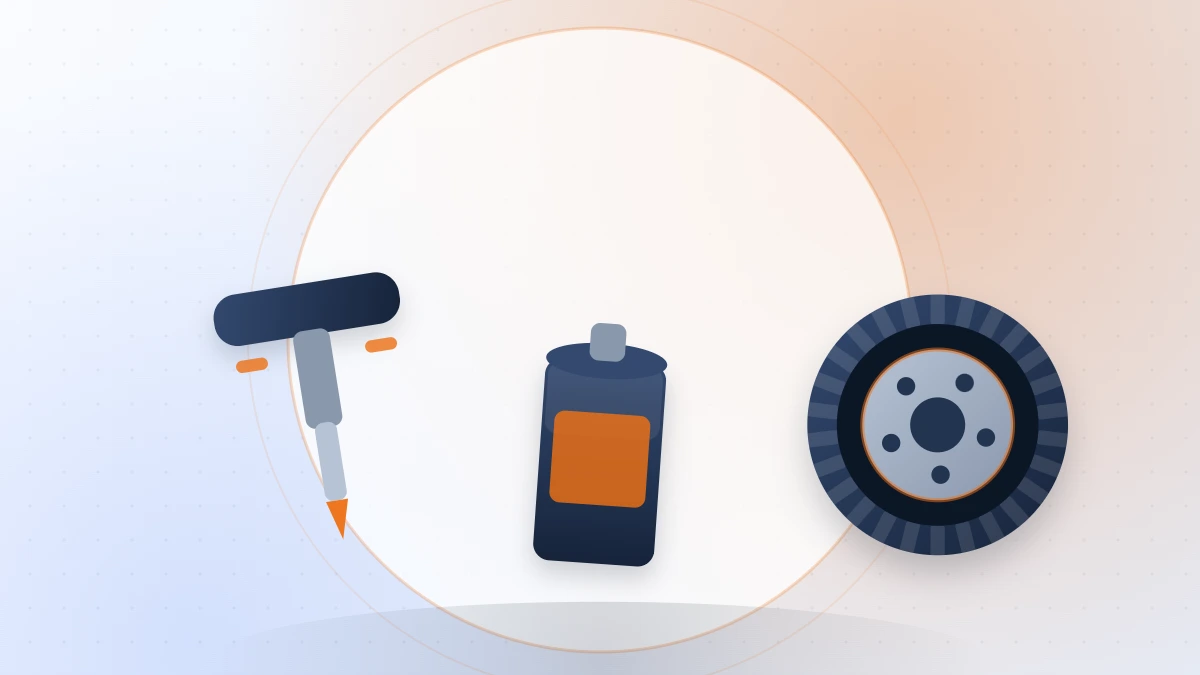
Carmakers replaced the spare wheel with a bottle of sealant and a compressor to save weight and boot space. For some punctures that is a perfectly good trade. For others it leaves you waiting for recovery, and it is worth knowing which is which before it matters.
What a sealant kit does
The kit is a small compressor and a bottle of latex-based sealant. You connect it to the valve, the sealant is pushed into the tyre, and the compressor inflates it while you drive slowly so the liquid spreads and plugs the hole from the inside.
It works well for: a small puncture in the tread, from a nail or screw, roughly up to 4 mm, with the object still in place or freshly removed.
It does not work for:
- Sidewall damage. The sidewall flexes constantly; no sealant holds there. This is the classic pothole and kerb failure.
- Large cuts or splits, where there is nothing for the sealant to bridge.
- A tyre that has already been driven flat, where the bead has unseated or the inner liner has been destroyed.
- A valve failure, where the leak is not in the tyre at all.
- A blowout.
That list covers a meaningful share of real roadside failures, which is why the kit is a partial answer rather than a replacement.
The costs people do not expect
Sealant expires. The bottle has a date, typically four to eight years, and dried sealant is useless. Most drivers have never checked theirs.
It usually costs you the tyre. Many fitters will not repair a tyre that has had sealant in it, and even where a repair is possible the mess adds labour. A puncture that a plug repair would have fixed for very little can become a new tyre.
It can damage the TPMS sensor. Direct sensors sit inside the tyre; sealant coats them. Kits sold as “sensor safe” exist and are worth choosing.
Speed and distance are limited. Typically under 80 km/h and under 200 km, and only to reach a fitter.
What a spare actually gives you
A space-saver is narrower and speed-limited, usually to 80 km/h, but it handles every failure above, including a destroyed sidewall. A full-size spare removes even the speed restriction, at the cost of weight and space.
The catch is that a spare is only useful if you can fit it: you need the jack, the brace, the locking wheel nut key, and enough physical ability to do it at the side of a road, in the dark, in the rain, on a slope. That is a real barrier for a lot of drivers, and it is the honest argument for the sealant kit.
A plug kit: the option nobody mentions
A tyre plug kit — a reamer, a rubber plug and insertion tool — repairs a tread puncture from the outside, permanently enough to reach a fitter, without contaminating the tyre or the sensor. It costs very little, takes up almost no space, and is what most people who deal with punctures regularly actually carry.
It requires you to find the hole and push reasonably hard, and it is not a legal permanent repair, but it works where sealant works and leaves the tyre repairable afterwards.
A sensible kit for most cars
- A plug kit and a small compressor as the first response to a tread puncture.
- The manufacturer’s sealant kit, in date, as a backup.
- Recovery cover you actually hold, for the sidewall failures nothing portable will fix.
- If your car came with a spare well, consider buying a space-saver, jack and brace second hand. Many owners of otherwise identical cars are selling them.
Before you need any of it
Check what is actually in your boot, today. Find out whether you have a spare, a kit or nothing. Check the sealant date. Confirm the locking wheel nut key is in the car and that you know where. Every one of those takes a minute now and none of them are possible to sort out on a hard shoulder.