
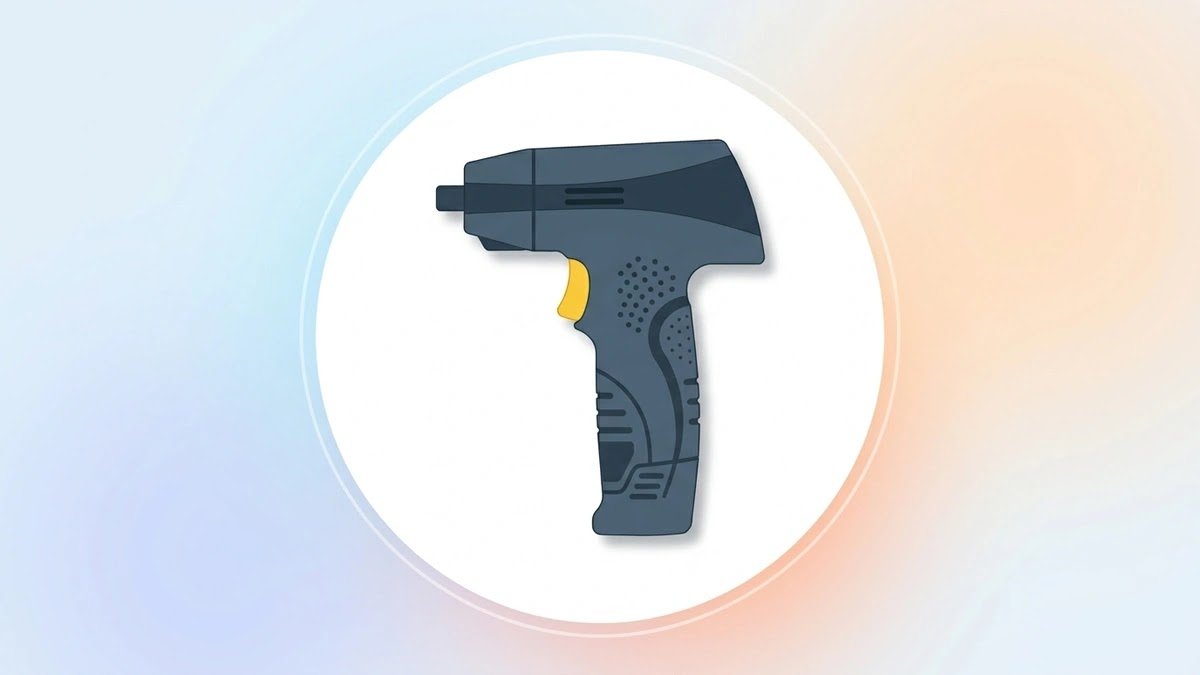
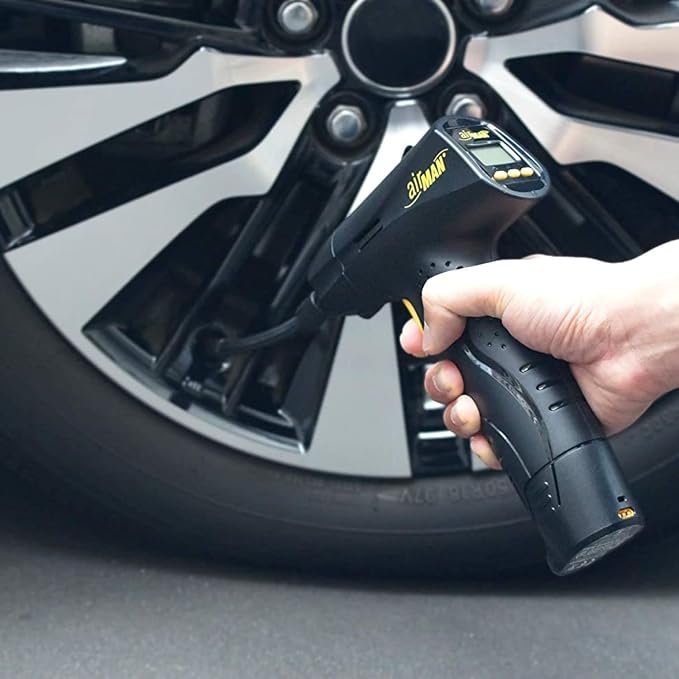
Nearly every tyre inflator on sale is the same object: a plastic brick with a hose, which you set on the ground next to the wheel while it hums away. The AirMan AirGun 2.0 is not that. It is shaped like a pistol, it weighs 600 grams, and it comes with a Presta valve adaptor and a ball needle in the bag. It is the strangest tyre inflator you can currently buy — and the story of who makes it is stranger still.
The company that took your spare wheel away
AirMan is a retail brand of Active Tools International, a company with arms in Bad Salzuflen in Germany, Troy in Michigan, and Shanghai. It describes itself as the leading Tier 1 OEM system supplier for tyre repair kits, and says it is one of very few manufacturers in the world that develops and makes both the compressors and the sealant in-house.
Read that again in plain language. If you bought a car in the last fifteen years and found a can of goo and a small compressor in the boot where the spare wheel used to be, this is the industry that put it there. Active Tools co-develops those kits with carmakers. The AirGun is what happens when a company that spends its days building compressors for other people’s badges decides to sell one under its own.
The company’s own origin story is that an engineer got fed up with a manual foot pump on a family bicycle trip and prototyped a cordless handheld pump, which it launched in the late 1990s as the first battery-powered handheld inflator on the retail market. That lineage explains the AirGun better than any spec sheet: it is a bicycle pump that grew up, not a car tool that shrank.
What AirMan actually publishes
| Weight | 600 g |
| Dimensions | 223 × 156 × 60 mm |
| Power | Rechargeable Li-ion; rated DC 12 V / 10 A |
| Air output | 23.4 L/min at 0 psi |
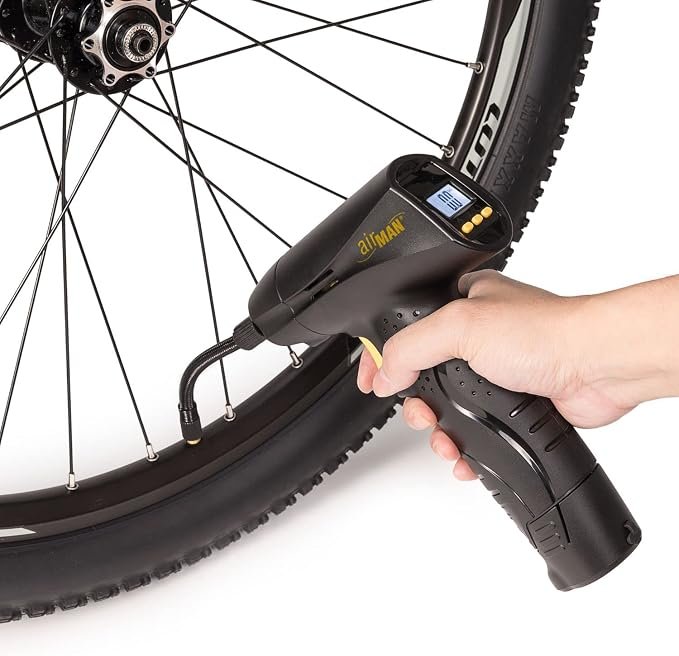
| Bicycle tyre (4.7 L) | 0 to 2 bar in under 2 minutes |
| Car tyre (P195/65 R15) | 0 to 35 psi in under 10 minutes |
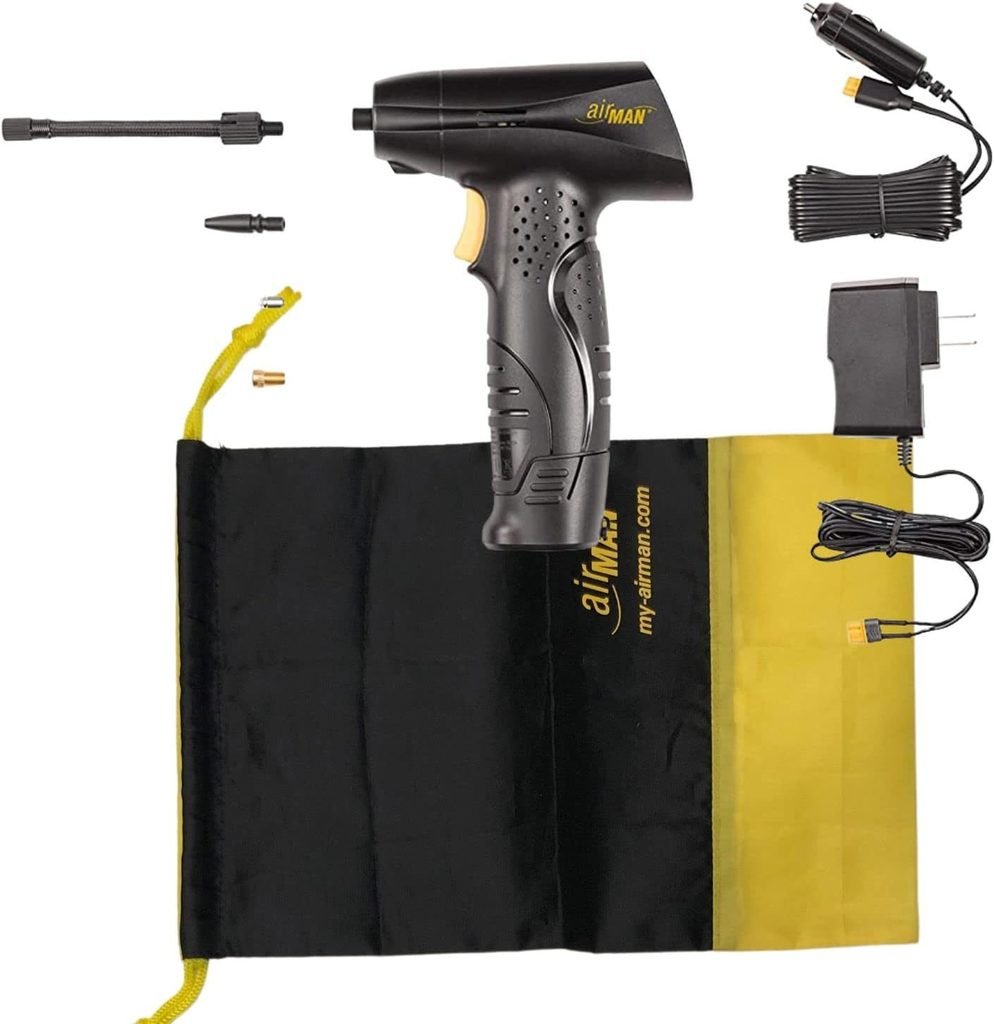
| In the box | Air hose with thread connector, mattress adaptor, ball needle, Presta valve adaptor, AC/DC charger, 12 V cord and car plug, nylon travel bag |
| Also | Digital display, automatic shut-off at target pressure, LED torch |
One number is conspicuously missing: AirMan’s own product page does not state a maximum pressure. Retail listings for the AirGun advertise 150 psi. That is a gap worth noticing — maximum pressure is the first figure most buyers look for, and the manufacturer leaves it to the resellers.
Why “23.4 litres per minute” is not the number you think
This is the part that matters for every inflator you will ever consider, not just this one, so it is worth slowing down for.
Flow ratings on small compressors are quoted at zero pressure — free air, pumping into the atmosphere against no resistance. AirMan is unusually honest about this and prints the condition right next to the figure: 23.4 L/min at 0 psi. Most brands quote the same kind of number and leave the condition off.
Real output falls away as the tyre pressure climbs, because the compressor has to work against its own output. That is why AirMan’s two inflation claims look so far apart. A bicycle tyre holding 4.7 litres of air at 2 bar takes under two minutes. A small car tyre — a 195/65 R15, one of the smallest sizes still common on the road — takes under ten minutes to reach 35 psi from flat.
Do the arithmetic on that before you buy. Four tyres from flat is most of an hour of continuous running on a 600-gram tool, and a bigger tyre on a modern crossover holds considerably more air than a 195/65 R15. The AirGun is a top-up tool — bring four tyres from 28 to 34 psi on a Saturday morning, inflate a bike, a football, an air mattress. It is not a roadside rescue tool, and nothing about how it is sold pretends otherwise.
That distinction — topping up versus re-inflating from flat — is the single most useful thing to hold in your head when comparing inflators. A device rated for one is often poor at the other, and the flow figure on the box will not tell you which you are looking at.
The genuinely weirdest one is not for sale to you
For context on what strange really looks like in this category: Aperia Technologies sells the Halo, a unit that bolts to the hub of a truck wheel and, in the company’s words, “uses the rotational energy of the wheel to automatically pump air into the tire and continuously maintain optimal pressure.” No battery, no socket, no hose — it runs on the wheel going round.
Aperia announced a steer-axle version in March 2026, due in the fourth quarter, which would cover every wheel position on a truck or trailer. It claims fuel savings of up to 1.4 per cent from lower rolling resistance. It is also sold exclusively to commercial fleets, from owner-operators up to Fortune 500 logistics companies, and there is no consumer version. A hub-mounted compressor that never needs charging is the strangest thing in tyre inflation — and you cannot buy one for your hatchback.
Who the AirGun is for
Buy it if the pistol format genuinely suits how you work — one hand on the tool, no brick sitting in the gravel, and a bag of adaptors that covers the car, the bikes, the paddling pool and the kids’ footballs. The auto shut-off at a set pressure is the feature that earns its keep, because it turns pressure setting from a job into a button. Coming from a Tier 1 OEM compressor maker, the mechanical side is likely to be better than the average white-label brick.
Skip it if you want something that will get you off the hard shoulder. For that you want higher sustained flow and a duty cycle the maker is willing to state — and you want to check the maximum pressure figure from the manufacturer rather than the listing, which in this case means asking, because AirMan does not print it.
Read next
NOTE We do not currently earn a commission from this link.