
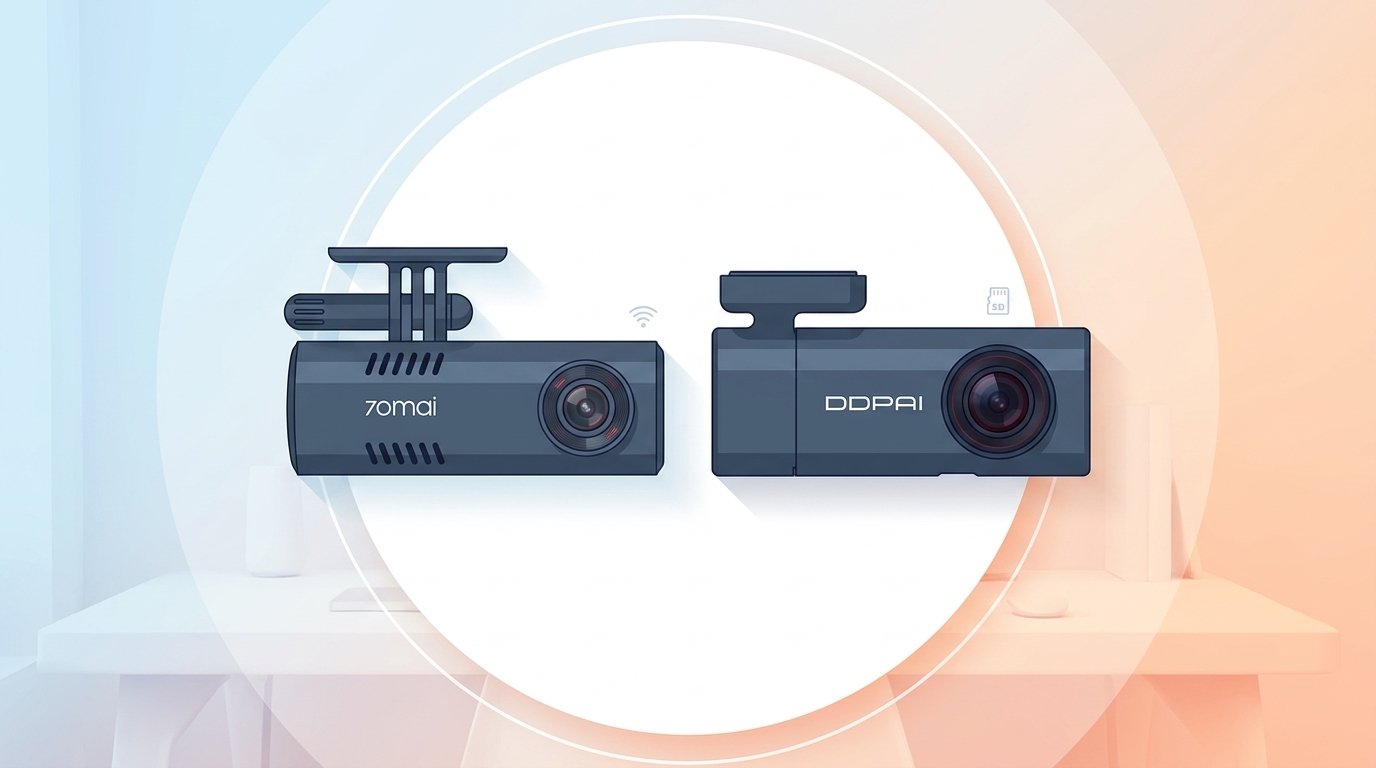
At the bottom of the dash cam market two names come up again and again: the DDPAI Mini Pro and the 70mai M310 Plus. Both are screenless rectangles that stick to the windscreen, both are controlled from a phone, both are sold as 2K, and both sit around thirty dollars. On paper it looks like a straight two-horse race.
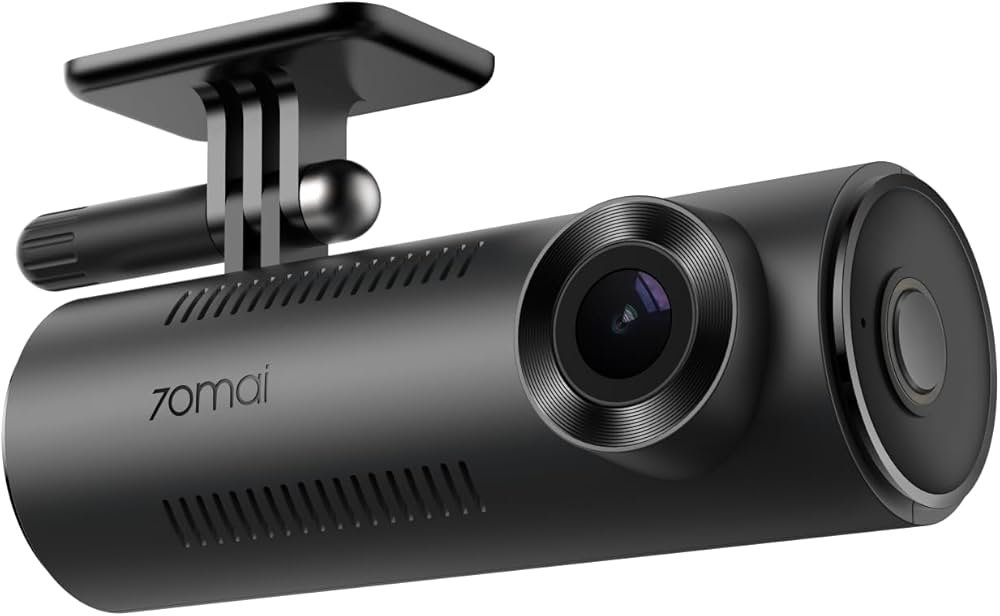
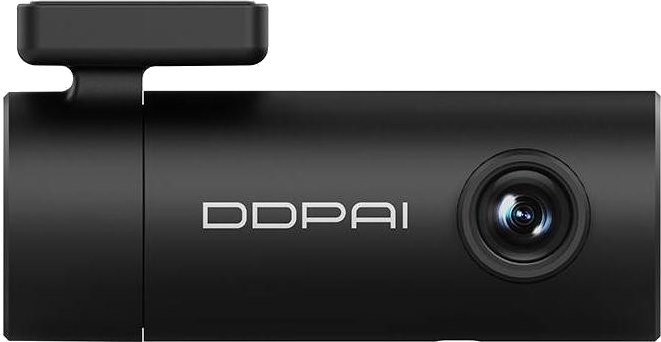
It is not, and the reason is worth more than the comparison itself: neither of these names refers to a single camera. Before you can decide which is better, you have to work out which one you are actually looking at.
Trap one: the same name covers different cameras
DDPAI’s own product page for the Mini Pro 2K lists 2560×1440, an F2.0 lens, a 121° field of view, a USB Type-C socket, a supercapacitor instead of a battery and support for microSD cards up to 256 GB. Go shopping, however, and you will find plenty of retail listings for a “DDPAI Mini Pro 2K” quoting 1296p, a 140° lens and a micro USB socket. Those are not typos. They describe an earlier camera sold under a near-identical name.
70mai plays the same game from the other direction. The M310 Plus exists as a 2K version, a 3K version and a 4K version, each with its own product page and its own sensor. “M310 Plus” on a listing title tells you almost nothing on its own.
The practical rule is simple. Ignore the model name in the listing title and check three things against the manufacturer’s page: the vertical resolution, the field of view in degrees, and the socket on the body. If a seller’s numbers do not match any official variant, you are looking at a listing written by somebody who has not seen the product.
Trap two: 2K is a marketing word, not a resolution
Both cameras are advertised as 2K. In this class that label gets attached to anything above 1080p, and 1296p and 1440p are both sold under it. The difference between them is about eleven per cent more vertical pixels, which sounds trivial and is not: number plates are read from a small part of the frame, and that is precisely where the extra rows land. Neither camera goes beyond 30 frames per second, which is normal here and adequate for reading traffic, though it will smear a plate on a car crossing quickly in front of you.
The number that decides night footage
If you only compare one specification on a cheap dash cam, compare the aperture. The 70mai M310 Plus 2K uses an F1.55 lens; DDPAI quotes F2.0 for the Mini Pro 2K. Light gathering scales with the square of that ratio, so F1.55 puts roughly 1.7 times as much light on the sensor as F2.0 — about two-thirds more, every frame, all night.
That is not a small edge in the conditions where a dash cam earns its money. A sensor starved of light has to raise gain, and raised gain is what turns a number plate into a grey smudge under sodium street lighting. Both manufacturers market night modes — 70mai calls its combination Super Night Vision with WDR, DDPAI calls its version NightVIS — but marketing names do not change the physics of the hole the light comes through. On specification alone, expect the 70mai to be the better camera after dark, and expect the gap to widen as the light drops.
Field of view: wider is not automatically better
The 70mai covers 143°, the current Mini Pro 2K covers 121°. That is a genuinely large difference and it cuts both ways. The wider lens catches the adjacent lanes and the pavement, which is what you want when somebody merges into your door. It also spreads the same number of pixels across more scene, so anything in the centre of the frame — the car in front, its plate — is described by fewer of them, and cheap wide lenses distort towards the edges. A narrower lens concentrated on the lane ahead is not a downgrade; it is a different bet about which accident you are insuring against.
The unglamorous differences that you live with
The socket. Current versions of both use USB Type-C, but older Mini Pro stock is micro USB, and that decides whether the cable in your glovebox is the same one that charges everything else you own. Check it on the listing photograph, not the description.
Power storage. DDPAI specifies a supercapacitor rather than a lithium battery in the Mini Pro 2K. In a car this matters: a supercapacitor tolerates a sun-baked windscreen far better than a small lithium cell, which is the component that usually kills a cheap dash cam in its second summer. It stores only enough charge to close the current file safely, which is all a dash cam needs.
Cards. Both specify a 256 GB maximum. Use a card sold as high-endurance; a standard card in a device that overwrites itself continuously will fail, and it will fail silently.
How this comparison was made. Every figure here comes from the manufacturers’ own current product pages for the DDPAI Mini Pro 2K and the 70mai M310 Plus 2K, cross-checked against retail listings where those disagree — and they do disagree, which is the point of the first section. We have not filmed with either camera, so there are no sample frames or subjective impressions here, and the conclusion about night performance is drawn from the optics rather than from footage. When we test these ourselves, this page will be rewritten with the results and the conditions they were shot in.
So which one
If most of your driving is in daylight and you want the widest possible view of what happens beside the car, the 70mai M310 Plus 2K is the more complete package on paper: more coverage, the brighter lens, a current socket and a manufacturer that publishes its variants clearly.
If you drive mostly ahead-facing motorway miles, park in the sun, and would rather have a narrower, less distorted frame with a supercapacitor behind it, the DDPAI Mini Pro 2K is a sound choice — provided you buy the current version and not the older camera wearing the same name.
At around thirty dollars, the honest answer is that either beats no dash cam by a distance that no specification sheet can express. The mistake to avoid is not picking the wrong brand. It is paying for 1440p and a USB-C socket and receiving 1296p and micro USB, because the listing said Mini Pro and you did not check which one.