
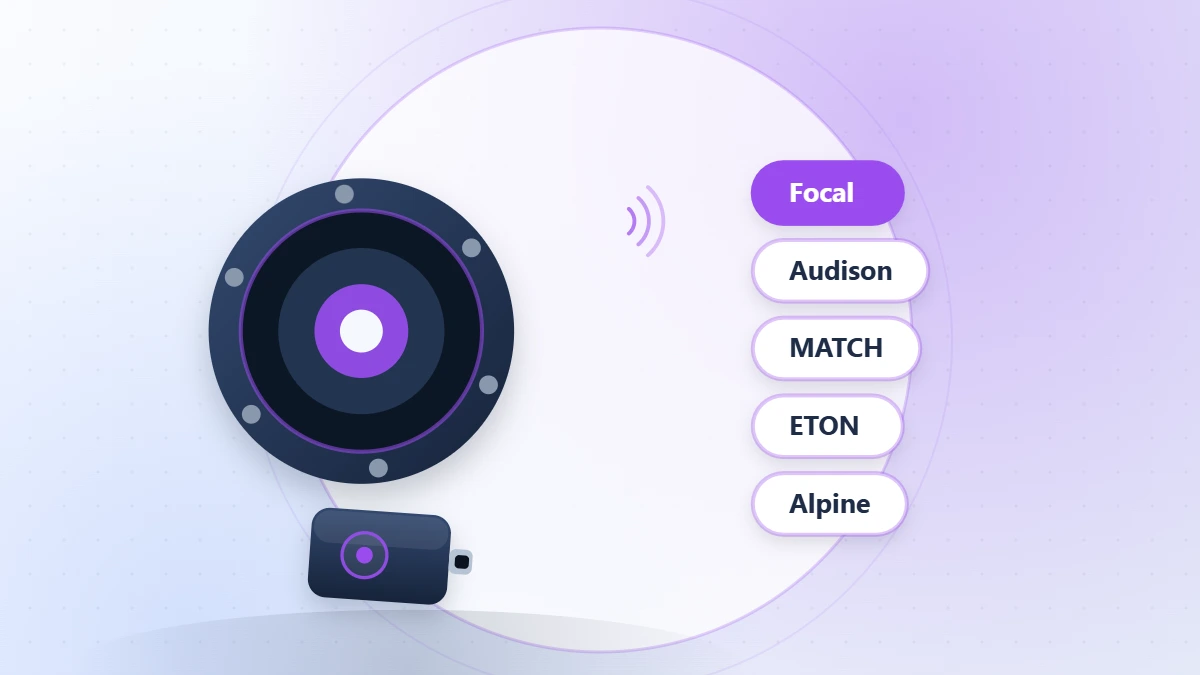
There are two ways to improve the sound in a modern car. You can buy a pair of universal speakers and make them fit, or you can buy a kit that was engineered for your exact model — right mounting flange, right depth, factory plugs on both ends, and a tuning that already accounts for the doors it is going into. The second route is what the industry calls plug-and-play, and on a car built after roughly 2010 it is usually the only route that produces the result people imagine when they start the project.
Why this category exists at all
Twenty years ago a car stereo sent a clean, flat signal to four identical speakers. That is no longer true. A factory system now arrives pre-equalised for the specific cabin, often already amplified, sometimes carried over a fibre-optic or digital bus rather than copper, and with the head unit welded into the car’s infotainment and diagnostics. Drop a good universal speaker into that and you inherit the factory’s correction curve, which was designed for the paper cone you just removed. It will be louder. It will not necessarily be better.
A vehicle-specific kit solves three separate problems at once: the mechanical one (a basket and depth that drop into the factory aperture with the supplied adapter), the electrical one (harnesses that plug into the factory connectors without a single cut wire), and the signal one (a DSP that undoes the factory equalisation and re-tunes the system for the new drivers). The third is the part universal speakers cannot address, and it is where most of the audible difference actually comes from.
The five systems worth knowing
| Brand | Line | Strongest at |
|---|---|---|
| Focal | Focal Inside | Coverage — over 50 makes and around a thousand model variants |
| Audison | Sound Pack, AP and AF series | BMW and Mini, and pairing with a bit-series processor |
| MATCH | UP series by Audiotec Fischer | DSP amplifiers wired for a specific car’s loom |
| ETON | Upgrade Audio | VW T-series vans, Mercedes, camper conversions |
| Alpine | Car Specific Sound Systems | Vans and motorhomes: Transit, Ducato, Boxer, Jumper, Sprinter |
How we chose — and what we did not do. These five are here because each maintains a genuine vehicle-specific programme with published fitment lists, factory harnesses and current stock, rather than a universal speaker sold with an adapter ring. The comparison is built from the manufacturers’ own catalogues and fitment tools. We have not installed or listened to these kits ourselves, so you will find no sound impressions or measurements here that we cannot stand behind. This is a map of the category and a fitment method, not a listening test.
Focal Inside — the one most likely to cover your car
Focal’s Inside programme is the broadest in the business: the company lists kits across more than fifty vehicle brands and roughly a thousand model variants, from Volkswagen and Ford to Tesla and Porsche. Kits are graded, so the same car may be offered as a straight speaker replacement, as a speaker plus subwoofer package, or as a full system with a dedicated amplifier and processor. You start on Focal’s vehicle selector, not in a shop.
Watch for: breadth means variation. Two cars from the same maker can get very different kits, and the cheapest tier for your model may be speakers only. Read what is actually in the box before comparing prices. Find your car in the Focal Inside selector
Audison Sound Pack — the BMW and Mini specialist
Audison, part of Italy’s Elettromedia, runs a vehicle configurator that builds a package for your car, and its BMW and Mini support is unusually deep — model-specific amplifiers such as the APBMW and AFBMW series, under-seat woofers designed for the factory cavity, and plug-and-play T-harnesses that tap the existing loom without cutting it. It is also the range that scales furthest upward, because the same harnesses feed Audison’s bit processors if you later want full DSP tuning.
Watch for: the depth is concentrated. If you drive a BMW, this is arguably the strongest option here; if you drive something else, check the configurator before getting attached to the idea. Open the Audison Sound Pack configurator
MATCH by Audiotec Fischer — the amplifier does the work
The German approach, and the most technically interesting of the five. MATCH’s UP-series amplifiers are built around a specific car’s wiring: the UP 7BMW and UP 8BMW, for example, connect to the factory loom, read the signal the car is already sending, strip out its equalisation and apply a tuning made for that model. Add the matching UP-S vehicle-specific speakers and the whole chain is designed as one system. If your complaint is that the factory sound is muddled rather than merely quiet, this is the family that addresses the cause.
Watch for: DSP is the expensive part of any kit, and this range leads with it. Expect the amplifier to cost more than the speakers. MATCH range and Upgrade Finder at Audiotec Fischer
ETON Upgrade Audio — vans and Volkswagens
ETON builds its Upgrade Audio line in Germany around individual vehicles rather than around a driver size, with front systems such as the UG VW T6 designed for one van’s doors and no other. The T-series Transporter and Mercedes vans are where the range is strongest, which makes it a common choice in camper conversions, where the doors are awkward, the cabin is enormous and the factory system is usually the cheapest one the manufacturer offered.
Watch for: distribution is European. Availability outside the EU is patchy and often goes through specialist importers. Browse ETON Upgrade Audio by vehicle
Alpine Car Specific Sound Systems — the practical choice for a camper
Alpine’s SPC series is built the same way — one part number per vehicle family — and the catalogue leans towards the vehicles people spend real time in: the Ford Transit and Transit Custom, the Fiat Ducato and its Citroën and Peugeot twins, the Sprinter, plus a run of passenger cars. Being Alpine, it is also the range you are most likely to find stocked locally and supported by an installer who has fitted it before, which matters more than a specification sheet when something does not line up.
Watch for: many SPC kits are speakers and adapters only. If your van has the basic radio, budget for amplification separately. Alpine car-specific sound systems by model
Three questions that decide which kit you can actually buy
1. Does a kit exist for your exact model, year and trim?
Fitment in this category is narrower than people expect. A facelift, a different infotainment generation or an optional premium audio package can change the answer for what looks like the same car. Every one of these five publishes a vehicle selector; use the manufacturer’s own tool and match the model year and the audio option code, not just the badge on the boot.
2. What signal is your factory system sending?
This is the question that decides the price of the whole project. A basic radio driving speakers directly is the simple case. A car with a factory amplifier needs a kit that either replaces it or takes a high-level input from it. A car using a fibre-optic or digital bus needs a specific interface, and no amount of speaker quality substitutes for having one. Find out which of the three you have before you shortlist anything.
3. Speakers only, or speakers plus DSP?
A speaker-only kit fixes the mechanical and electrical problems and leaves the factory tuning in place. It is a real improvement and the cheaper half of the category. A kit with a processor also corrects the signal, which is what makes a system sound designed rather than merely upgraded — and it roughly doubles the cost. Neither is wrong; deciding which one you are buying before you look at prices saves a lot of confusion.
Common questions
Can I fit one of these myself?
A speaker-only kit, usually yes: the hardest part is removing door cards without breaking clips. A DSP-amplified kit involves finding a mounting location, routing looms and running a software tune, and most owners hand that to an installer.
Will it void my warranty?
The reason these kits use factory connectors and cut nothing is precisely so the car can be returned to standard. That is a strong position to be in, but warranty terms vary by manufacturer and market, so confirm with your dealer rather than with a forum.
Is a kit worth it over good universal speakers?
On an older car with a simple radio, universal speakers plus an adapter ring remain excellent value. On a recent car with a pre-equalised or amplified factory system, the kit exists because the universal route hits a ceiling that no amount of extra spend on drivers gets past.
Why can I not just order one online?
You often can, but the order of operations matters. Fitment is the product here, so the part number has to come from the manufacturer’s own vehicle selector before you go looking for a price. Marketplace listings for vehicle-specific kits are patchy and sometimes mismatched to the model in the title, and a kit for the wrong infotainment generation is not a kit you can return easily. Confirm the part number first, then shop it.
Links go to each manufacturer’s own vehicle selector, because fitment has to be confirmed against your exact model, year and audio option before price matters. We earn nothing from these links, and no manufacturer has paid for a place on this list. Last updated: 5 September 2026.