
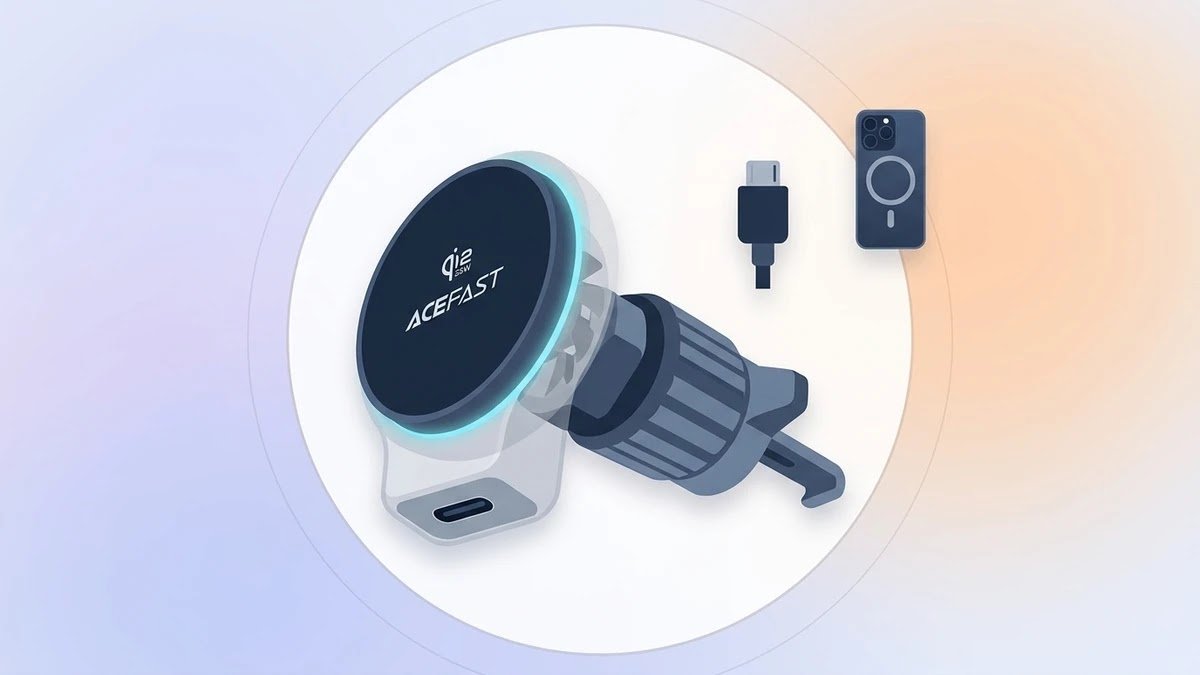
Wireless charging is not new, and neither is its oldest complaint. Drop a phone onto an ordinary magnetic pad and twenty minutes later the back of it is hot. The phone then does exactly what it was designed to do: it cuts the charging current to protect the battery, and the fast charging you paid for quietly turns into slow charging. A new wave of Qi2 chargers answers that with a fan built into the puck itself, and ACEFAST’s vent-mounted version is one of the cheapest ways to try the idea.
A turbine on the air vent
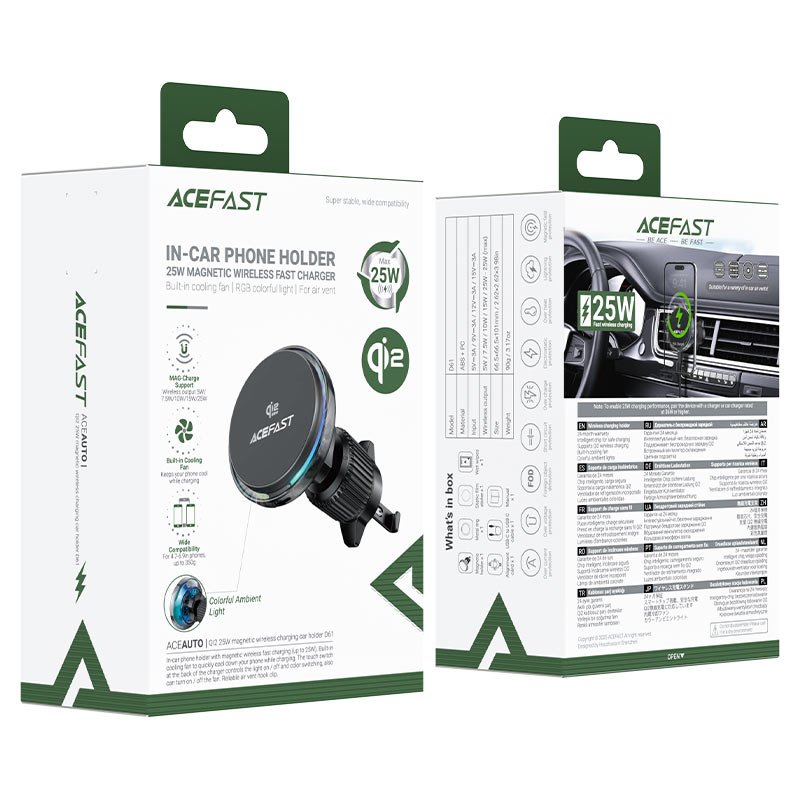
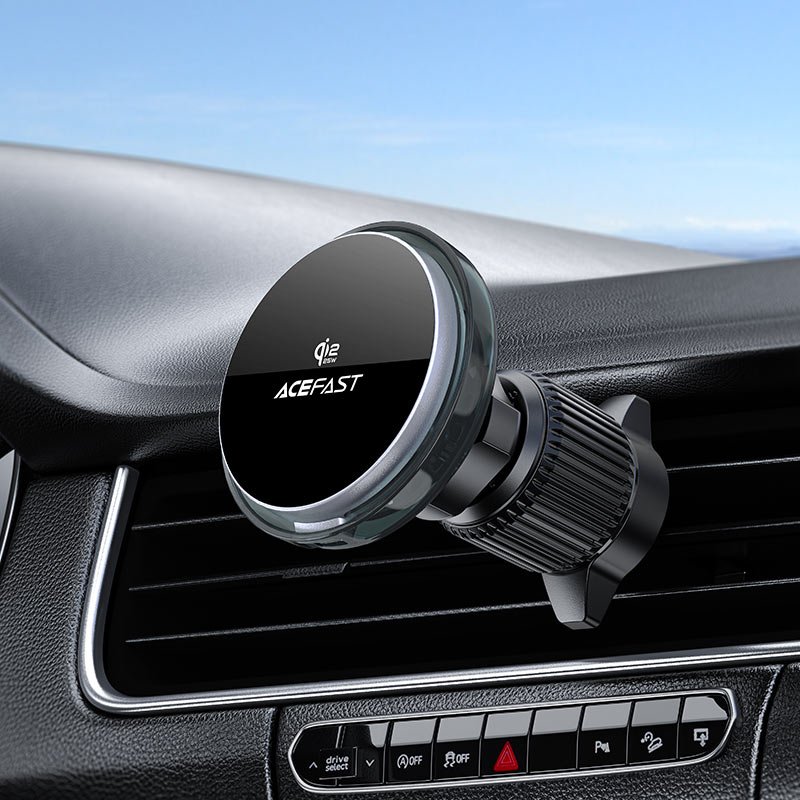
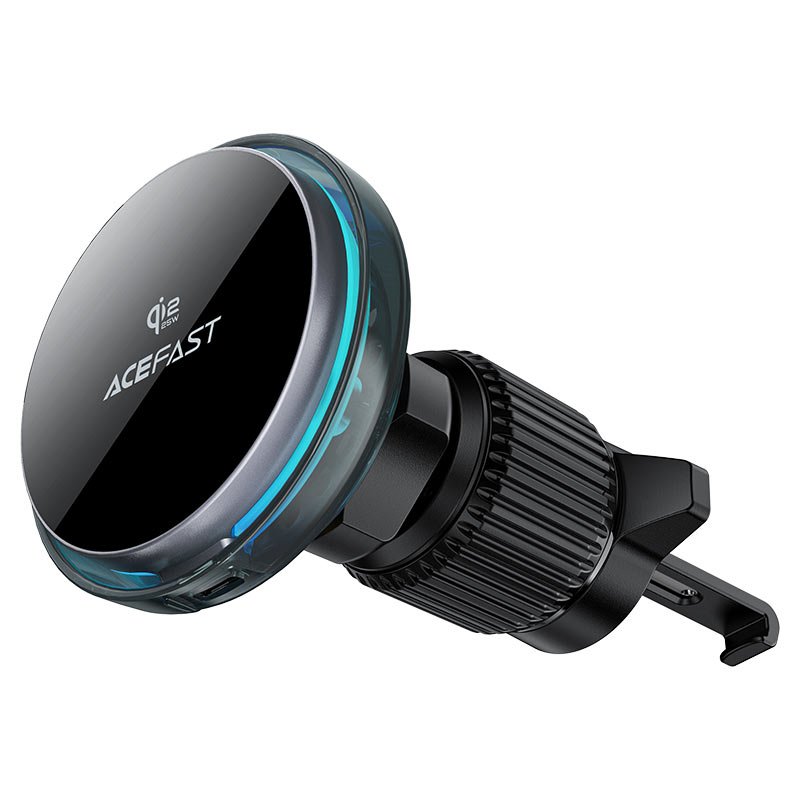
The thing looks less like an accessory and more like a miniature turbo from a sports car, and that is not only styling: there is a real cooling fan inside the housing. ACEFAST sells it in two flavours. The D61 is the showy one, with touch-controlled RGB ambient lighting around the rim and a ball joint for angling the phone; the D66 is the plainer sibling with the same cooler and no light show. The same design turns up under other brand names as OEM versions, which is why you will find it at very different prices.
The magnet block is the other half of the story. Quoted pull is around 1.6 kg, which in practice means a large flagship in a thick magnetic case stays put over broken tarmac rather than sliding off on the first pothole. The mount takes phones from 4.7 to 6.9 inches and up to 350 g, and clips to a vent blade with a hook rather than a friction clamp.
What the meter actually shows
The headline figure is Qi2 at 25 W, and that number comes with a condition that is easy to miss: you need a USB-C Power Delivery adapter of 45 W or more feeding it. Plug it into a 20 W car adapter and you will never see the speed the box promises.
In testing on Samsung and Google Pixel handsets, an inline power meter read 26–28 W going into the charger. Part of that is the fan and the conversion losses in the coil, so the phone itself is getting its honest 25 W rather than 28. With the fan switched off, a Pixel pulled closer to 30 W through the same charger — interesting, but not free speed: 25 W is the ceiling the standard allows into the phone, so the difference goes to heat, not to the battery.
The part that actually matters: temperature
Numbers on a meter are the easy part. The reason to buy a charger with a fan is what happens over the following half hour. The face of the pad stays genuinely cool while it works, because the heat is being pulled out of the sandwich instead of soaking into the phone’s back glass. The phone therefore never trips its thermal limit, never tapers, and holds close to full speed from the first percent to the last — which is the whole point, and something a passive pad in a sun-warmed car simply cannot do.
One clarification worth making, because listings blur it: this is a fan, not a thermoelectric cooler. It moves heat away efficiently, but it cannot take the surface below the temperature of the cabin around it. Chargers advertised with “semiconductor cooling” or a Peltier element are a different, and usually pricier, class of device.
Price, and the alternative
The family sells from roughly $20 to $40 depending on the seller and the variant, from desktop pucks to the car holders. The obvious alternative is UGREEN’s MagFlow line, which does the same job with better materials and a more established name — for one and a half to two times the money.
If premium materials and brand status matter to you, pay the difference. If what you want is honest fast charging with cooling that works, in a mount that will not drop your phone, the cheap version is the better buy — provided you also budget for the 45 W adapter that makes it live up to its rating.