
Starlink Mini was designed to be carried, not driven. SpaceX ships it with a fold-out kickstand, and the official specification sheet rates the antenna at 298.5 × 259 × 38.5 mm and 1.10 kg — a laptop-sized panel meant to be set down on the ground, a table or a windowsill. Nothing in that package says “roof of a car at motorway speed”.
Closing that gap is the entire business of Adaptis, a Ukrainian manufacturer that has built a complete accessory ecosystem around putting a Mini — or a full-size Gen 3 dish — on a vehicle and keeping it fed from the car’s electrical system. The company runs an English storefront with prices in US dollars, which makes it worth a look even if the name is new to you.
First, what Starlink Mini actually needs
No third-party kit makes sense until you know the constraints. These come from SpaceX’s own published specification sheet for the Mini, not from a reseller:
| Antenna size | 298.5 × 259 × 38.5 mm |
| Weight | 1.10 kg (1.16 kg with kickstand) |
| Average power draw | 25–40 W |
| DC input | 12–48 V, 60 W |
| USB-C PD input | 100 W minimum (20 V / 5 A) |
| Ingress protection | IP67 Type 4 |
| Operating temperature | −30 °C to +50 °C |
| Wind, operational | 96 km/h and above |
| Wi-Fi | 802.11 a/b/g/n/ac, up to 128 devices |
Two lines matter most in a vehicle. The DC window starts at 12 V, which means a car’s nominal 12 V rail sits right on the bottom edge of what the terminal will accept — and the alternative, USB-C Power Delivery, needs a 100 W source that almost no 12 V socket charger provides. The wind figure is reassuring but often misread: it describes a stationary dish in moving air, not a certification for driving.
The mount: a plastic shell and four magnets
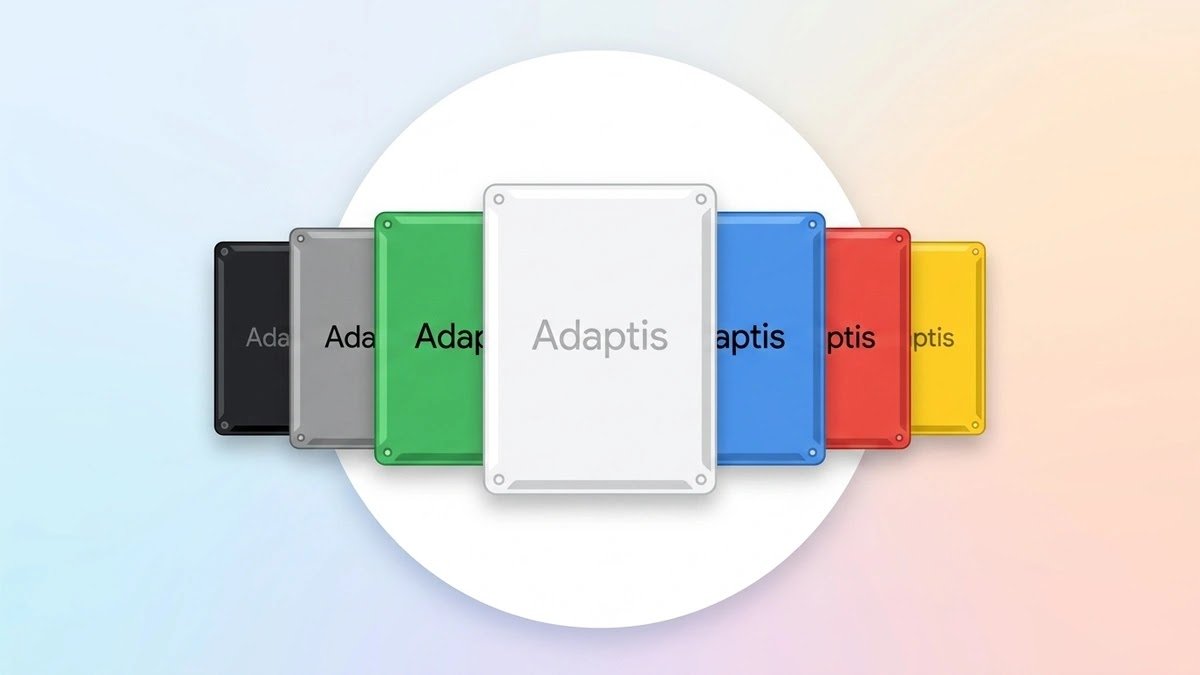
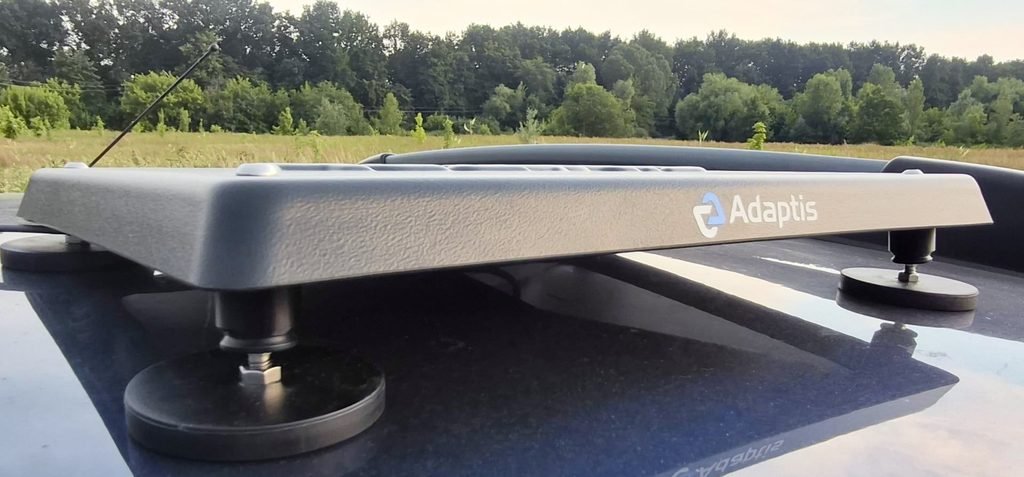
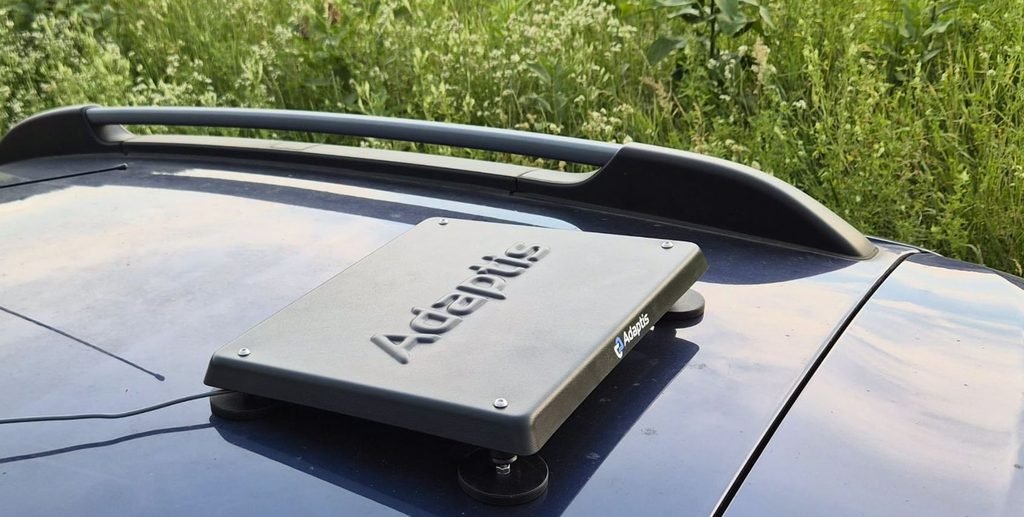
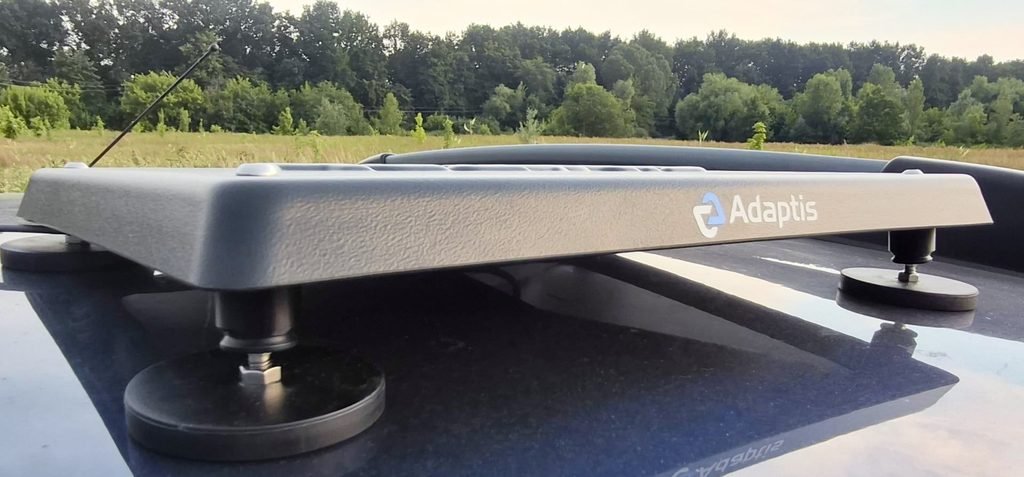
The core product is the Adaptis MiniKit — a 3 mm ABS housing with UV protection that the terminal drops into. It measures 305 × 380 × 58 mm and weighs 1 kg empty, 2.1 kg with the Mini inside. It attaches with four 66 mm rubberised neodymium magnets on articulated steel floating supports; the articulation is the important detail, because car roofs are curved and a rigid four-point mount would only ever touch on two. Stock colours are black, white, grey and olive, with custom finishes offered as a paid option.
Adaptis rates each magnet at over 45 kg of pull force, and that number deserves context rather than repetition. Pull force is measured on flat, clean, bare steel with full contact and force applied straight up. Paint, curvature and the rubber protective layer all reduce it. More to the point, the load that matters at speed is shear — the magnet sliding sideways — and shear strength is a fraction of pull strength. The four-magnet redundancy and the low, faired profile do more for security here than the headline figure does.
And the obvious one: a magnetic mount needs a ferrous roof. Aluminium roof panels are increasingly common, and a panoramic glass roof is a non-starter. Test yours with a fridge magnet before you order anything.
Power: why the adapter outputs 36 volts
The cleverest item in the range is also the dullest-looking: a 65 W adapter that takes 12–24 V from the vehicle and delivers a regulated 36 V to the Mini’s DC connector, listed at $49.
Why boost the voltage instead of feeding 12 V straight in, when the terminal accepts it? Arithmetic. At 12 V, a 40 W load pulls more than 3 A, and a cigarette-lighter circuit plus a few metres of thin cable will sag under that — leaving the terminal at the very bottom of its acceptance window and vulnerable to brownouts when the engine drops to idle. At 36 V the same 40 W is roughly 1.1 A: less voltage drop, a cooler cable and real headroom. It also sidesteps USB-C PD entirely. For the larger Gen 3 dish, which needs considerably more, the company lists 12–56 V supplies instead.
Around that sit the rest of the ecosystem: a 160 W car charger with two USB-C ports and one USB-A, and the P2Fit battery pack from $245, which shows charge level, live draw and estimated runtime on a colour display — useful when the terminal is the single biggest load in a parked vehicle.
What it costs
- MiniKit housing on its own — from $195
- Housing + 12–24 V adapter — from $239
- Housing + Type-C cable + power bank — from $349
- Starlink Mini terminal + MiniKit housing — from $609
- Terminal + housing + 12–24 V adapter — from $642
- G3kit housing for Starlink Gen 3 — from $225
Figures are taken from the manufacturer’s English storefront at the time of writing and exclude shipping and any import duty.
Five things to settle before you order
- Roof material. Magnets need steel. Aluminium panels and glass roofs rule the magnetic mount out entirely.
- Your service plan. Using Starlink while the vehicle is moving is a subscription question, not a hardware one — it requires one of Starlink’s mobile plans, and availability differs by country. Confirm the terms for your region before buying hardware around it.
- Total height. The housing adds 58 mm plus whatever your roof rails already contribute. Multi-storey car parks, height barriers and drive-through car washes become things you have to think about. Automatic car washes are simply out.
- Support at a distance. This is a Ukrainian manufacturer selling direct. The English store and dollar pricing are real, but check what shipping to your country costs and what a warranty claim would actually involve before you pay.
- Local rules. Some jurisdictions regulate roof-mounted equipment, overhang and load. Worth a five-minute check against your national road rules.
Who it is for
Overlanders, camper and van conversions, survey and utility crews, film units, rally support vehicles — anyone whose work or travel routinely leaves cellular coverage behind. The company says it was founded in January 2023 to solve connectivity for a humanitarian organisation running vehicles in conflict areas, and it cites railway and defence deployments since. Whatever weight you give the origin story, it does explain why the products read as field equipment rather than lifestyle accessories: thick plastic, camouflage cover options, boring reliable power electronics.
What it is not for is a road trip through a country with decent mobile coverage. There, a phone hotspot is cheaper, lighter and quicker. The case for a roof-mounted dish begins exactly where the cell towers end.
Read next
NOTE We do not currently earn a commission from this link.