
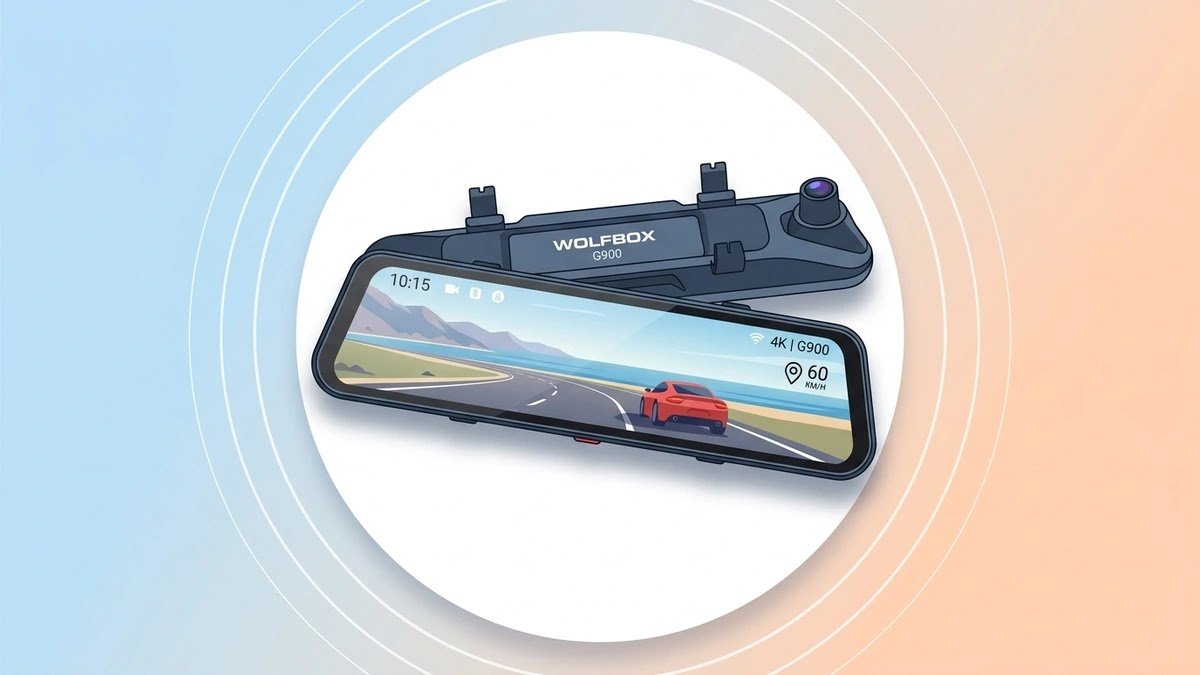
The Wolfbox G900 TriPro replaces your rear-view mirror with a 12-inch touchscreen and records in three directions at once: forward through the windscreen, backward through a camera at the tail of the car, and inward at the cabin. It is a lot of hardware to hang off a mirror stalk, and most of the decisions that matter happen before you buy rather than after.
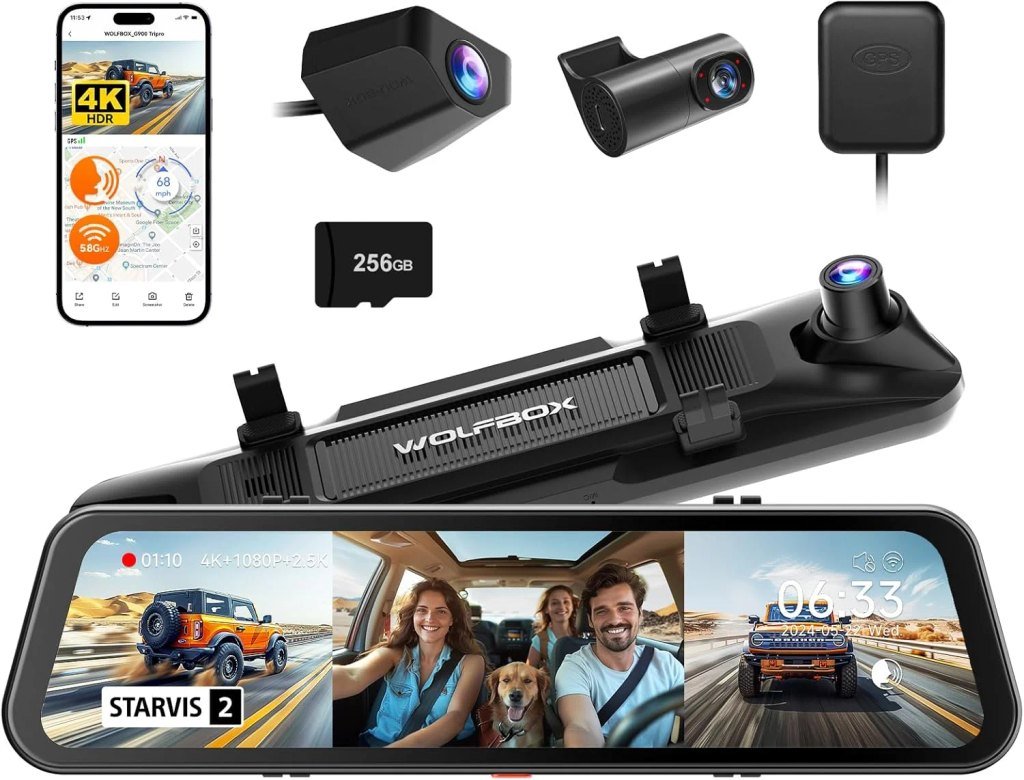
First: there are two TriPros, and they are not interchangeable
This is the single most important thing to get right, because the names are almost identical and the products are not.
- Cabin Version — the third camera points inside the car. This is the one linked above, and the one for anyone carrying passengers.
- Bumper Version — the third camera mounts at the front bumper, low down, for a second forward angle.
Everything else about the two is the same. Buying the wrong one leaves you with a camera pointed at entirely the wrong thing and a return to arrange, so check which variant a listing is before you click. If you drive for a living with people in the back, you want the Cabin Version — that inward camera is the entire reason the product exists.
The specification, and what each line means
| Front camera | 4K, Sony IMX678 (STARVIS 2), 170° field of view |
| Rear camera | 2.5K, OmniVision OS04J10, 150° field of view |
| Cabin camera | 1080p with four infrared LEDs |
| Recording modes | 4K/30fps front + 2.5K/30fps rear + 1080p/25fps third channel; front can be dropped to 2.5K or 1080p |
| Screen | 12-inch IPS touchscreen, mirror replacement |
| Power storage | Supercapacitor |
| Connectivity | Built-in GPS, 5.8 GHz Wi-Fi, voice commands |
| Parking mode | 24-hour monitoring with G-sensor impact detection — requires a hardwire kit |
| Storage | microSD; Wolfbox’s own store lists the card as not included, retail bundles often add 256 GB |
| Operating range | -20°C to +70°C (-4°F to 158°F) |
| Price and warranty | $399.98 on Wolfbox’s own store at the time of writing, with an 18-month warranty the company describes as exclusive to buying direct |
Two lines in there deserve more than a glance.
The supercapacitor is the right answer, and it is worth knowing why. Cheap dash cams use a small lithium battery to finish writing a file after power is cut. Lithium hates the inside of a parked car — a dashboard in summer sun comfortably exceeds the temperature at which those cells degrade, swell and occasionally fail messily. A supercapacitor holds far less energy but tolerates heat and tens of thousands of charge cycles. It is the difference between a camera that survives four summers and one that does not, and it is the first thing worth checking on any dash cam at any price.
The third channel is the weak one. 1080p at 25fps is noticeably below the other two, and 25fps in particular is a frame rate chosen to match mains-frequency lighting rather than to capture fast motion. Inside a cabin, watching people sit still, that is entirely adequate. On the Bumper Version, pointed at traffic, it is a real limitation — which is another argument for being clear about which variant you are buying.
What owners and testers report
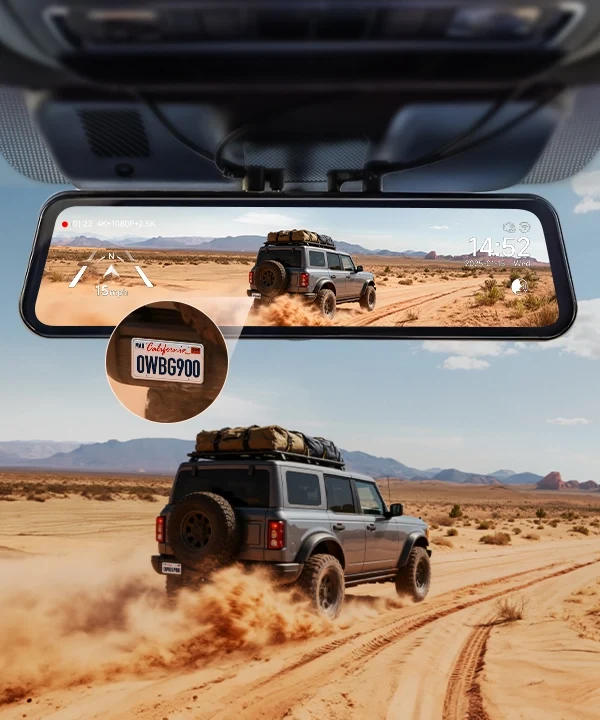
Independent hands-on coverage of the Cabin Version lines up on the same points. Installation on the supplied 12 V cable is straightforward; the mirror straps hold without vibration. The 12-inch screen is bright and responsive, the phone app is well behaved for pulling clips, and the front camera reads number plates and road signs at speed and after dark, which is the only thing a dash cam is ultimately bought to do.
The complaints are also consistent, and they are practical rather than damning:
- The cabin camera’s cable is short, which constrains where you can put it. Plan the placement before you start routing trim.
- The on-screen menus are dense. Testers describe the settings interface as overwhelming and end up leaning on voice commands while driving.
- Parking mode is not included in the price. The 24-hour monitoring needs a hardwire kit, sold separately in the base bundle. Anyone buying this camera for parking protection should add that to the budget from the start.
What the manufacturer does not publish
Two numbers are missing, and both matter more than most of what is on the spec sheet.
Bitrate and codec. “4K” describes the pixel count, not the quality. Two cameras recording 4K at wildly different bitrates produce wildly different footage, and it is the bitrate that decides whether a number plate survives compression. Wolfbox does not publish either figure, and neither does most of the industry — but that is why 4K on a box is a weaker promise than it looks.
Maximum card capacity. Nor is there a stated requirement for card endurance, which is the thing that actually bites. Dash cams write continuously and overwrite constantly; an ordinary microSD sold for phones and cameras will fail in this duty cycle, often silently, leaving you with a camera that has been recording nothing for weeks. Buy a card marked high endurance, and check the footage every few months regardless of what the screen says.
The mirror question
Mirror dash cams are a genuine format with a genuine trade-off, and it is not really about the cameras.
In favour: a 12-inch live feed from a bumper-mounted rear camera shows more than any mirror can, and it does not get blocked by headrests, passengers or luggage. For anyone who regularly drives with a loaded boot or a full car, that alone is the argument.
Against: it replaces a piece of safety equipment that has worked reliably for a century with a screen. A screen has a boot time, a failure mode and a glare problem that glass does not, and your eyes refocus differently between a display at arm’s length and a mirror reflecting objects thirty metres behind you — which is a real adjustment for some drivers and a persistent annoyance for others. Most units let you switch the display off and use the surface as a plain mirror, which is the sensible fallback and worth confirming you can reach quickly.
Who it is for
The Cabin Version has one obvious audience: anyone who carries passengers for money. Rideshare and taxi drivers need an inward-facing camera with infrared, because the disputes they face are about what happened inside the car, and they happen at night. On that job this is a well-specified tool, and the front camera is better than it needs to be.
For a private driver with nobody in the back, the cabin channel is dead weight and the Bumper Version — or a straightforward two-channel camera at half the price — makes more sense. Before ordering, check your local rules on recording passengers: in much of Europe an inward camera in a commercial vehicle carries notification obligations that a forward camera does not.
Read next
NOTE This is the Cabin Version, not the Bumper Version. Buying direct from Wolfbox costs more but carries a longer stated warranty. We do not currently earn a commission from this link.