
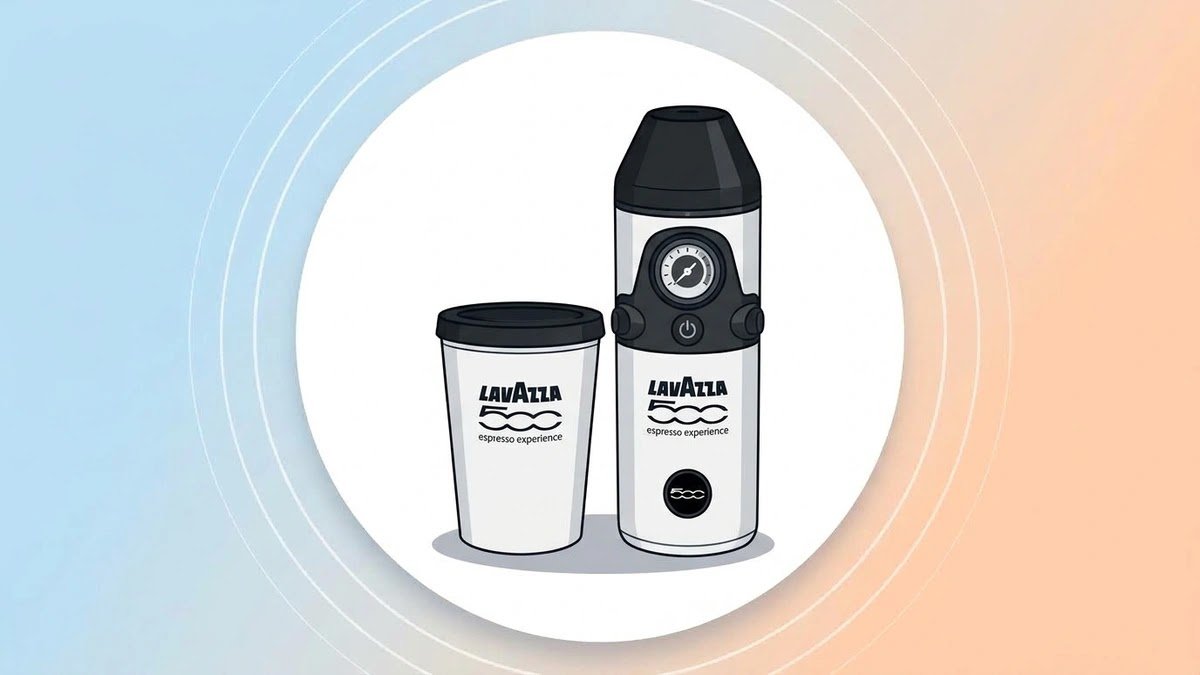
Every few months another 12-volt coffee gadget appears, promising espresso from the cigarette lighter socket. All of them are chasing something that happened once, properly, at the factory: between 2012 and 2022 you could order a Fiat 500L with a real espresso machine built into the centre console, fitted by Fiat, developed with Lavazza, for about €250.
It remains the only production car ever sold with one. It is also, mechanically, far more interesting than the gadget aisle gives it credit for.
How it actually worked
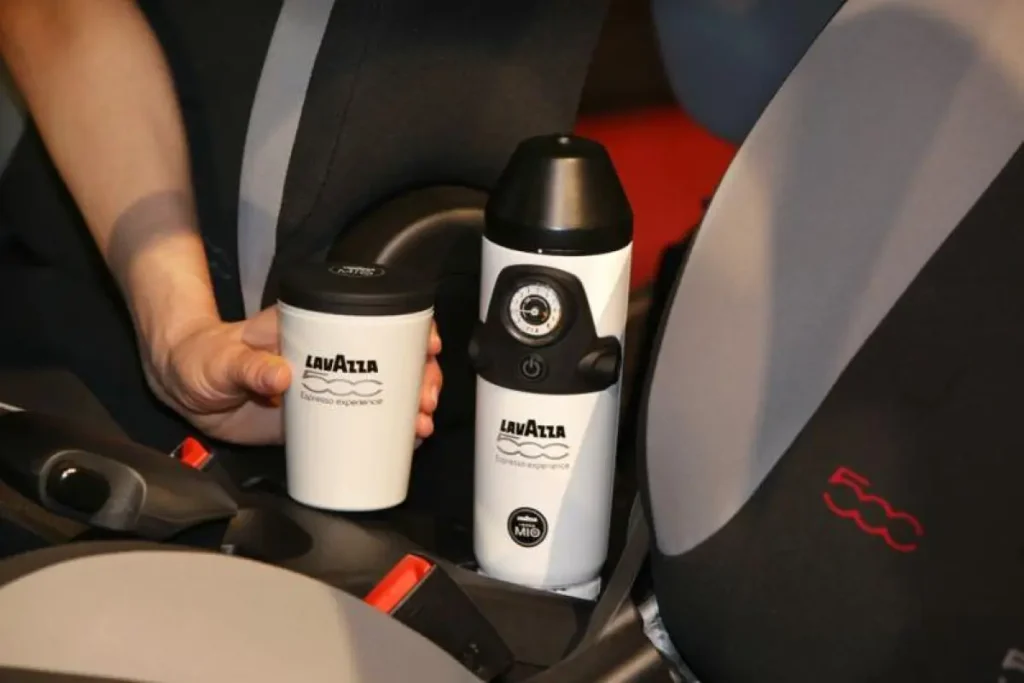
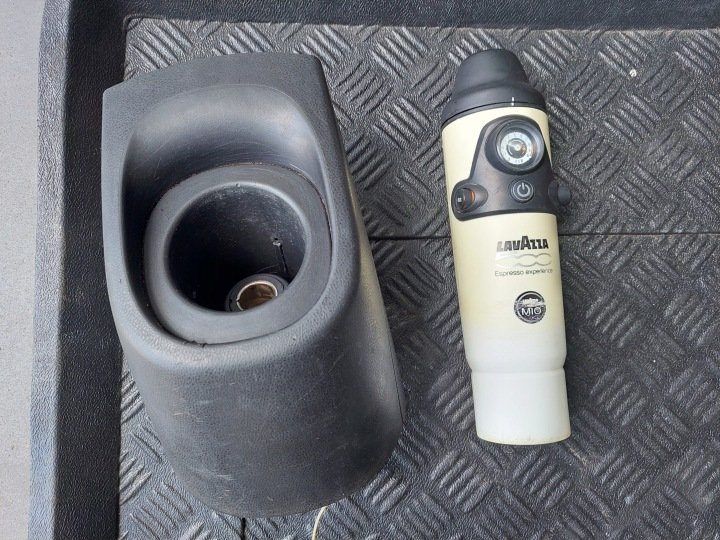
The unit sat in a dedicated dock between the front seats. Not a 12 V plug hanging off an accessory socket — a powered cradle designed into the console, which is the difference between a factory option and an aftermarket accessory.
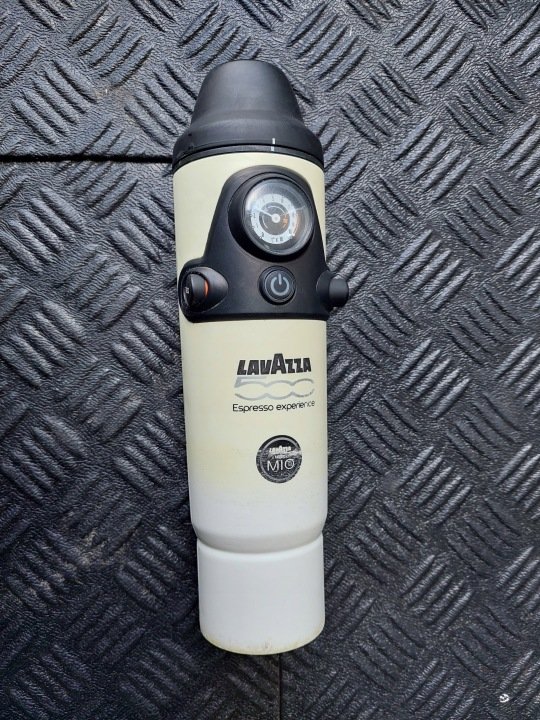
The sequence went like this: fill the reservoir, drop a Lavazza A Modo Mio capsule into the portafilter, close the lid, seat the machine in its dock, press start. The dock heated the water. Then — and this is the part worth pausing on — you lifted the machine out, turned it upside down over your cup, and pressed the button to extract.
That inversion is the clever bit. A kitchen espresso machine is a fixed object with a drip tray and a plumbed path from group head to cup. Neither exists in a car. By separating the heating stage, which needs power and a stable dock, from the extraction stage, which needs to happen directly over a cup wherever the cup is, Fiat and Lavazza sidestepped the whole problem of running hot pressurised water through a vehicle interior. The machine goes to the cup. The cup never has to go to the machine.
The full “Coffee Experience” option added vehicle-specific cups, a spoon holder and a sugar container, which tells you the thinking went beyond the hardware to the fact that a car has nowhere to put a teaspoon.
The safety answer, which came first
The obvious objection arrived immediately in 2012, and it is the right objection: a driver juggling a hot inverted appliance is not a driver watching the road.
Fiat had already answered it. The machine only operated when the vehicle was stopped. Not a warning label, not a chime — an interlock. You could not brew while moving.
It is worth noting how much better that is than what most modern in-car gadgets do, which is put a touchscreen menu in front of a moving driver and print a disclaimer in the manual. Fiat removed the possibility rather than discouraging the behaviour. Two decades of distracted-driving research since has not produced a better pattern than that one.
About that 16-bar figure
The machine was specified with a 16-bar pump, against the 15 bar quoted on most consumer espresso machines, and the marketing made the most of the extra bar. It is worth knowing what that number is, because it will follow you around every coffee machine you ever shop for.
Properly extracted espresso is brewed at around 9 bar at the coffee itself. That is the figure baristas and machine designers care about, and it has been the accepted target for decades. The 15 or 16 bar on the box is the pump’s maximum unrestricted pressure, measured with nothing resisting it — a specification of the pump, not of the coffee. Going from 15 to 16 does not make better espresso any more than a car with a 260 km/h speedometer is faster than one reading 240.
None of which makes the Fiat unit bad. It simply means the number used to sell it was the wrong number, which is true of nearly every espresso machine sold anywhere.
The specification
| Developed with | Lavazza |
| Capsules | Lavazza A Modo Mio |
| Pump | 16 bar peak |
| Water per brew | 50 ml |
| Mounting | Powered dock in the centre console between the front seats |
| Interlock | Operates only with the vehicle stopped |
| Price | Around €250 as an option |
| Announced | 12 July 2012, at the 500L launch in Turin |
| Markets | Europe only — never offered in the United States |
| Car | Fiat 500L, built at Kragujevac in Serbia, 2012-2022 |
Why it never crossed the Atlantic, and why it died
Two reasons were given for keeping it out of America, and both were honest. One was liability: a hot appliance in a car is a burns claim waiting to be filed, in a market considerably more litigious than Italy. The other was duller and probably decisive — A Modo Mio capsules were not widely sold in the United States, so the option would have shipped with a consumable most owners could not conveniently buy.
That second point is the one with a lesson in it. A closed capsule system in a car ties the usefulness of a fitted option to one company’s distribution network. It worked in Italy. It would not have worked in Kansas, and it will not work in any market where the pods are not on a supermarket shelf.
The machine went away with the car. The 500L finished production in 2022 after a decade at Kragujevac — it had passed 500,000 units by early 2018 — and no replacement carried the option forward. Nobody else has tried since.
Why in-car coffee is genuinely hard
If you are tempted by one of the 12 V espresso gadgets sold today, the Fiat is a useful benchmark, because the hard part is not the coffee. It is the electricity.
Heating water is the most power-hungry thing a small appliance does, and a car’s accessory socket is a thin pipe. A 12 V socket fused at 15 A can deliver around 180 watts at the absolute limit, and many are fused lower. A kitchen espresso machine draws somewhere between 1,000 and 1,500 watts. That is roughly an order of magnitude, and no amount of clever design closes it.
Which means every 12 V coffee device makes the same trade: small volumes, long heating times, or both. Fiat’s 50 ml per brew was not a design flourish, it was arithmetic. If a gadget promises a mug of coffee from a cigarette lighter socket in under a minute, the number that is wrong is one of those three.
The honest alternatives split two ways. Manual pump espresso makers use no electricity at all — you supply the pressure by hand and the hot water from a flask, which neatly removes the entire problem. Or you accept the wait: a 12 V device that takes several minutes to heat 50 to 80 ml is doing exactly what physics allows, and the ones claiming otherwise are either drawing from a battery pack they did not mention or not getting the water as hot as espresso needs.
The point
The 500L espresso machine is remembered as a joke about Italian stereotypes, and it was partly that — Fiat knew exactly what it was doing by putting a Lavazza machine in a car launched in Turin.
But it was also a properly engineered answer to a real problem, with a safety interlock better designed than most things fitted to cars today, and a two-stage brewing method that solved the one constraint a car imposes. Fourteen years on, nothing sold in the accessory aisle has improved on it. That is not nostalgia. It is just where the engineering stopped.