
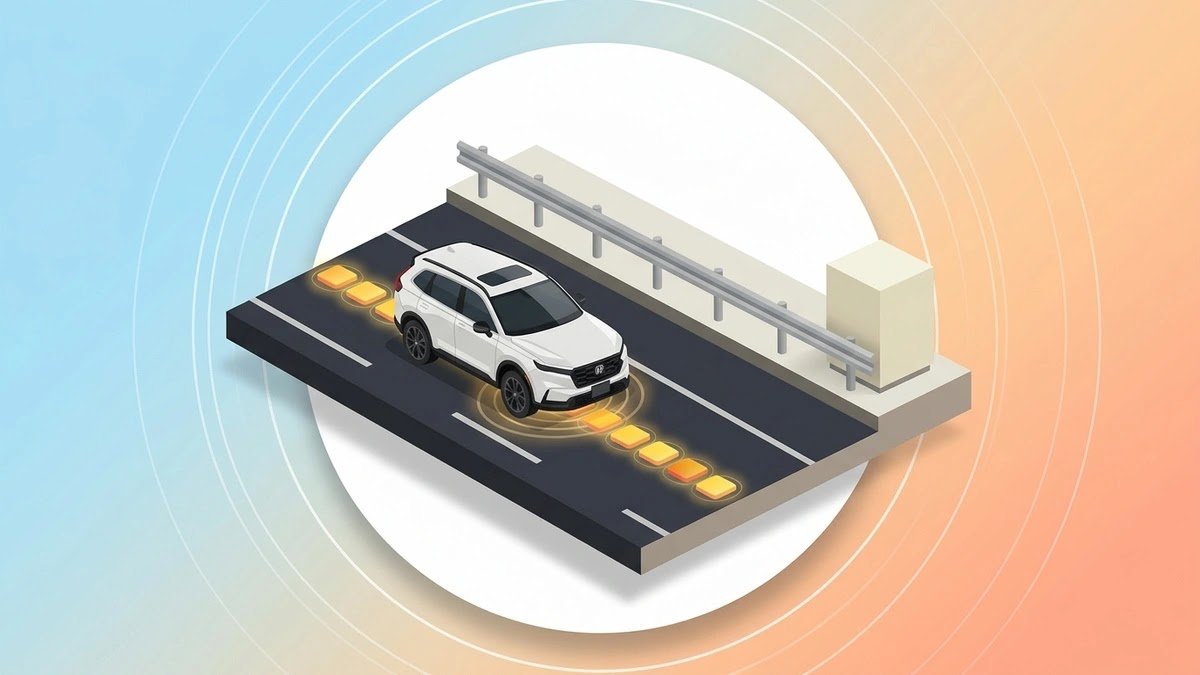
On 5 October, Honda announced that it has built the underlying technology for charging electric vehicles wirelessly while they drive, straight from the road surface. Public-road testing starts on a Japanese expressway in fiscal 2027.
Then read the subtitle on Honda’s own press release, which most coverage skipped: “including large commercial vehicles.” This is not being built for your hatchback.
What was actually announced
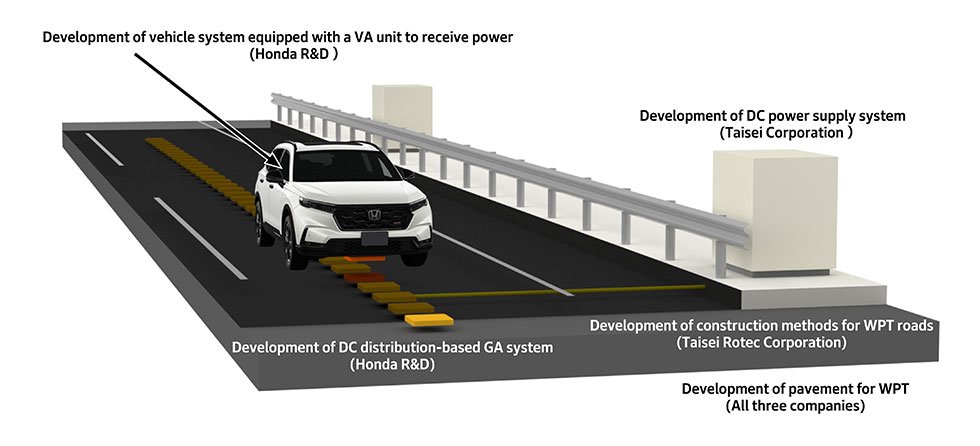
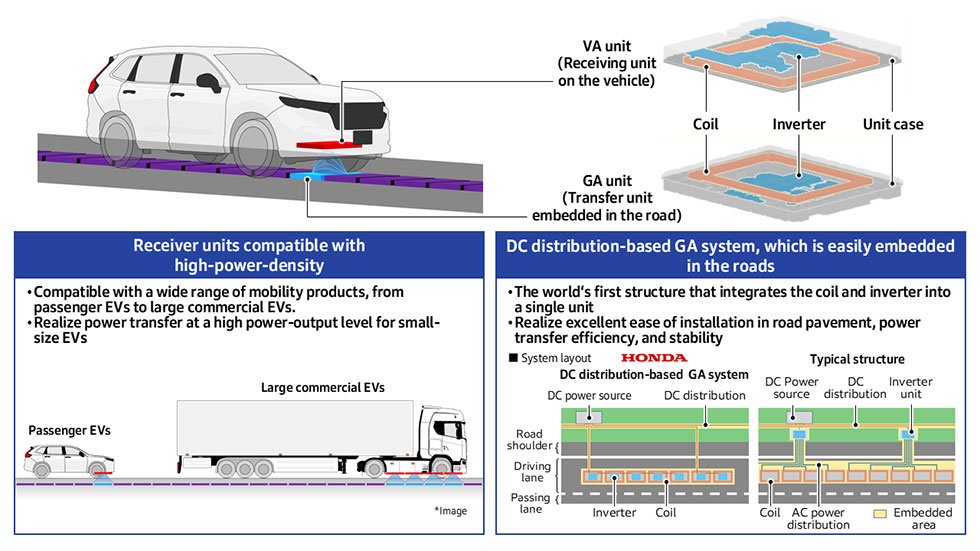
Honda R&D developed it with Taisei Corporation and Taisei Rotec. The system has three pieces: a high-response DC power supply at the roadside, power transmitter units embedded in the road itself, and a receiver on the vehicle. Energy crosses the gap by magnetic coupling — the same principle as the charging pad on a bedside table, scaled up and buried in asphalt.
Honda’s claimed world first, by its own research as of September, is combining the inverter and the coil into a single embedded unit. That sounds like an engineering footnote. It is actually the whole story.
The hard part was never the physics
Wireless power transfer is century-old science. Putting it under a motorway is a civil engineering problem, and the numbers Honda published are about roads, not electricity.
The embedded units are designed to survive vehicles of around 20 tonnes gross weight. A planned test subjects the pavement to one million wheel loads at 49 kN per wheel — roughly five tonnes landing on a single tyre contact patch, a million times. The units are installed by milling a channel into existing pavement rather than rebuilding the road, and the DC distribution layout exists to cut the number of components buried under traffic.
Every one of those decisions is about a road surviving trucks, frost and resurfacing. That is where this kind of project usually dies.
Why trucks and not cars
Honda names logistics and transport as the first target market, with verification planned at up to 150 kW for large commercial vehicles.
The economics are the reason. Electrifying a lane costs the same whatever drives over it, so the question is how much energy you can sell per kilometre of buried hardware. A fleet of heavy trucks running the same corridor every day, consuming three to four times what a car does and losing money every hour they sit at a charger, is a customer. Private cars drifting past at random, already charged at home overnight, are not.
There is a second reason. A long-haul truck’s battery is the enemy of its payload — every kilowatt-hour is weight that cannot be freight. Charging continuously from the road is the one thing that lets an electric truck carry a smaller battery, which is worth far more to an operator than convenience is to a commuter.
What Honda did not say
No efficiency figure. For wireless power that is the number — how much of what goes into the road reaches the vehicle, and how much becomes heat. Honda published nothing on it, nor on operating frequency, air gap, or the power levels of the first tests. There are no cost figures either.
Timing deserves care too. Fiscal 2027 in Japan begins on 1 April 2027, and what starts then is a demonstration on the Tateyama Expressway in Chiba, run with NEXCO East as part of the existing Tateyama Project. A demonstration is not deployment.
So: a real announcement, with real engineering behind it, aimed at freight corridors rather than commuters. The road that charges your car while you drive remains what it has been for a decade — plausible, expensive, and somebody else’s turn first.