
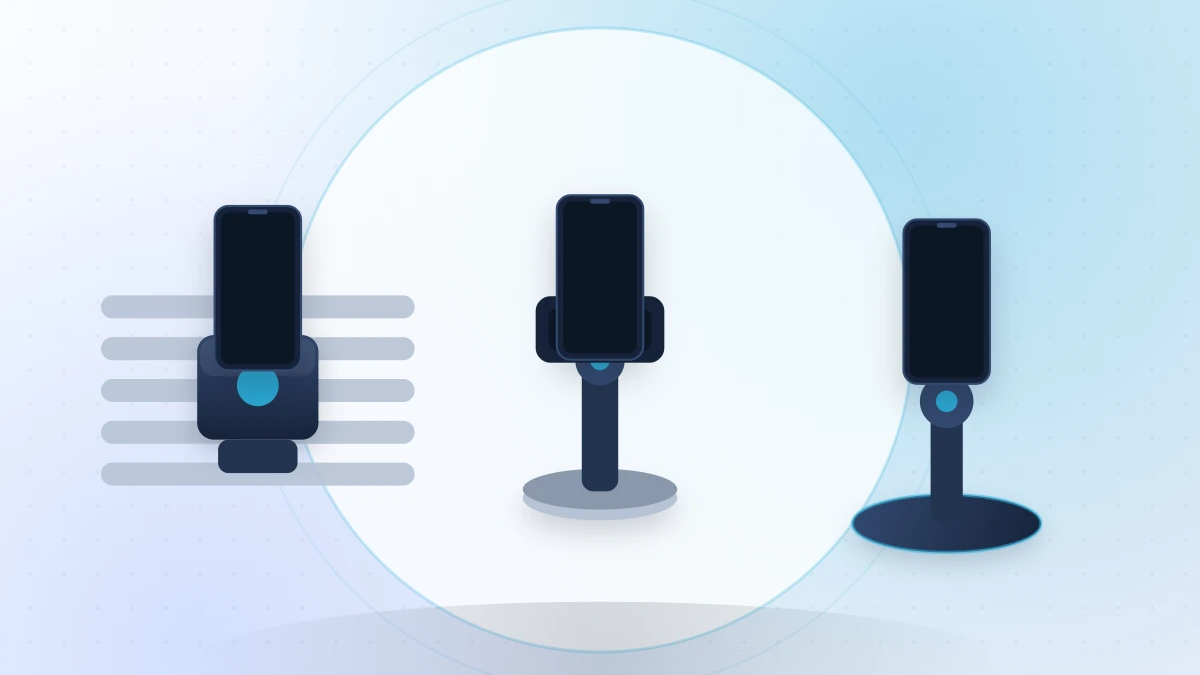
Almost every complaint about phone mounts comes down to one thing: the phone wobbles. Understanding why makes the choice straightforward.
Why mounts vibrate
Every mount is a small cantilever. The phone is a mass on the end of an arm, and the arm has a natural frequency. When road vibration hits that frequency, the phone oscillates visibly.
Two variables dominate:
- Arm length. A long adjustable arm is a longer lever and a lower natural frequency, which sits closer to the vibration a car actually produces. Short arms are dramatically more stable.
- Attachment stiffness. A mount anchored to something rigid moves less than one clipped to a thin, flexible vent fin.
Everything else — ball joints, telescopic sections, extra hinges — adds joints, and every joint adds movement.
If your phone shakes, shorten the arm before buying a different mount. It solves the problem more often than a new purchase does.
Vent mounts
Clip to the air vent fins. Compact, close to the dashboard, and normally the shortest arm available.
- Good: minimal vibration, phone at a natural height, nothing stuck to the car.
- Less good: blocks one vent, and hot or cold air blows straight at the phone. Heat is the enemy of both battery health and charging speed.
- Watch out for: thin or vertical fins, and vents that pivot under load. Some cars have fins that simply cannot take the weight of a large phone.
Best for most drivers, provided the vent design suits it.
Dashboard mounts
Adhesive pad or weighted friction base on top of the dashboard.
- Good: very stiff when adhesive-mounted, keeps the phone low and near the natural sightline.
- Less good: adhesive can mark or damage textured dashboards, and a sunlit dashboard is the hottest place in the car. Weighted friction bases slide under hard braking.
- Watch out for: placement over a passenger airbag. Never mount anything in an airbag deployment path.
Best when the vents are unsuitable and there is a flat area low on the dashboard.
Windscreen mounts
Suction cup on the glass, usually with the longest arm.
- Good: works in any car, adjustable, high position.
- Less good: the longest lever, so the most vibration. Suction fails in heat and cold. It sits in your field of view, and many countries restrict what may be attached to the windscreen and where.
- Watch out for: legality. Rules on windscreen obstruction vary by country and are enforced.
Best as a fallback, and worth mounting as low on the glass as the arm allows.
Cupholder and CD-slot mounts
Cupholder mounts are stable and very much out of the way — often too far out of the way, low and requiring a glance downward. CD-slot mounts are excellent where a slot still exists: the slot is rigid, the arm is short, and the height is close to ideal.
Magnetic versus clamp
Magnetic mounts are faster one-handed, have no moving parts, and hold well if the magnet ring is strong and correctly positioned. They need a magnet in the phone or case; a thick non-magnetic case will not do.
Clamp mounts hold anything, including phones in thick cases, and generally survive rough surfaces better. Spring-loaded clamps need two hands; motorised clamps do not, but add electronics that can fail.
Magnetic wins on daily convenience. Clamp wins on universality and heavy phones.
Choosing well: a short checklist
- Shortest arm your position allows. This is the single biggest factor.
- Rigid attachment point — a solid vent fin, a flat dash area, or a CD slot.
- Out of the airflow if the phone charges while mounted.
- Out of direct sun, for the same reason.
- Not in your field of view, and legal in the countries you drive in.
- Rated for your phone’s weight — a large glass-backed phone in a case is heavy.
- Not blocking an airbag, a control or a vent you rely on.
Get placement and arm length right and almost any well-made mount performs. Get them wrong and no mount will.