
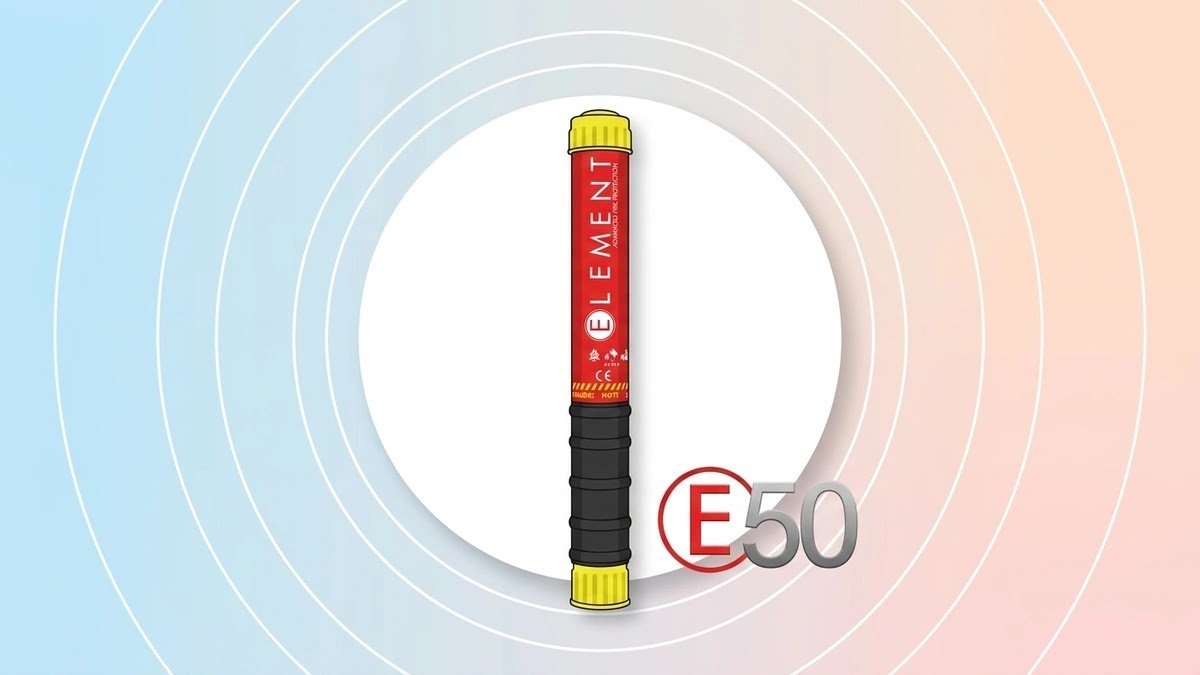
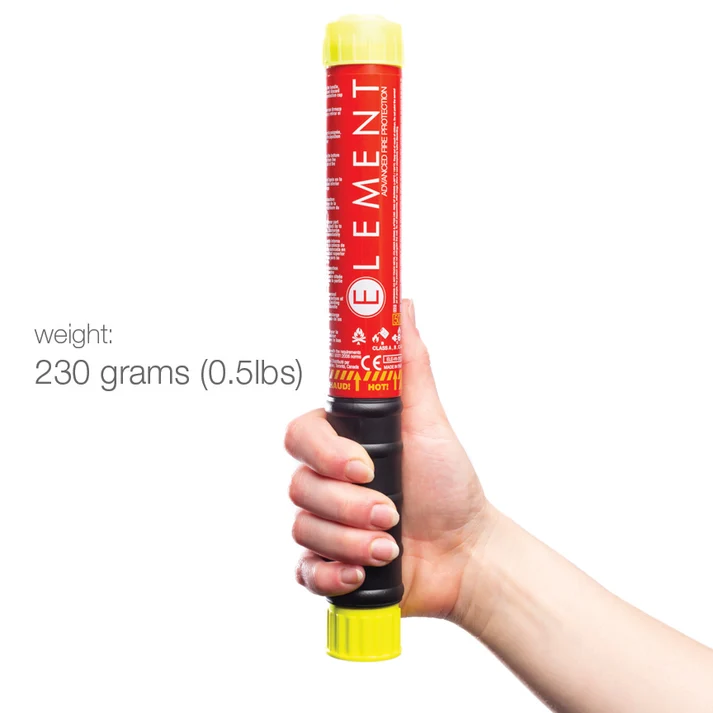
The Element E50 is 27 centimetres long, 3.2 centimetres across, weighs 230 grams and discharges for 50 seconds. It holds no pressure, contains no gas, has no moving parts, needs no servicing and — according to its maker — has no expiry date. It looks like a road flare and is used like one: you strike it.
It is a genuinely different approach to putting out a fire in a car, with real advantages and one caveat that European drivers in particular need to read before buying.
How it works
A conventional extinguisher is a pressure vessel. It stores an agent — powder, foam, CO₂ — behind a valve, and uses stored pressure to throw it at the fire. That is why it needs annual inspection, why the gauge matters, and why it eventually expires.
The Element stores nothing under pressure. It is a solid charge that you ignite, and it burns. Per the manufacturer, the active chemistry is potassium nitrate with an organic oxidiser and a plasticiser resin; burning it releases a stream of microscopic potassium particles — around 3 to 4 microns — along with nitrogen and water vapour.
What those potassium particles do is the interesting part, and it is well-established chemistry rather than marketing. A flame is a chain reaction sustained by free radicals — fragments of molecules, principally H, O and OH, that keep regenerating each other and propagating combustion. Potassium radicals bind to those chain carriers and remove them from the cycle. The fire does not run out of fuel or oxygen. Its chain reaction simply stops being able to continue.
This is the same principle used by fixed condensed-aerosol suppression systems in server rooms and machinery spaces. Element’s contribution is packaging it as a stick you keep in the door pocket.
The specification
| Discharge time | 50 seconds (the E100 does 100) |
| Size | 27 × 3.2 cm |
| Weight | 230 g |
| Operating temperature | −50 °C to +80 °C |
| Agent | Solid potassium-nitrate charge, no pressure, no propellant |
| Maintenance | None; manufacturer states no effective expiration |
| Rated for | Labelled ABCK, including cooking oil and grease |
| Not for | Open live-coal fires — wood, logs, campfires |
| Made in | Italy |
| Price | $89.95 on the manufacturer’s own store at the time of writing |
That temperature range is the quietly impressive line. A device rated from −50 °C to +80 °C can live in a car year-round, in a Nordic winter or a parked cabin in August, without the pressure loss and seal degradation that plague a conventional cylinder left in a boot for a decade.
Fifty seconds versus eight
A small ABC powder extinguisher of comparable portability empties in roughly 8 to 10 seconds. The E50 runs for 50.
Anyone who has used an extinguisher under stress will recognise why that matters. Eight seconds is less time than it takes most people to aim properly, and a half-discharged powder extinguisher that has been swept at the flames rather than the base of the fire is a very common failure. Fifty seconds allows for getting it wrong first, then getting it right.
The trade-off is range. A pressurised extinguisher throws its agent 4 to 6 metres. The Element has no propellant at all — the jet is described by the maker as “free of thrust” — so you have to be close to the fire for it to work. That cuts both ways: no pressure also means no blast scattering burning liquid, which is a real hazard when powder meets a fuel spill.
The certification question — read this before you buy
Element states that its products carry CE marking, TÜV certification and approval from the Italian maritime authority, and that military and police organisations use them. The Porsche Club of America accepts them for track events.
What it is not: UL Listed, and not certified to EN 3.
That distinction decides whether this device satisfies the law where you drive. Around thirty European countries require a fire extinguisher to be carried in a car — among them Poland, Romania, Bulgaria, Greece, Slovakia, Slovenia, Serbia, the Baltic states, Belgium, Ukraine and most of the Nordics. Those requirements are generally written around EN 3, the European standard for portable fire extinguishers, often with a valid inspection date.
An aerosol device is a different product category with its own European standard — EN 16856, covering portable aerosol dispensers for fire-extinguishing purposes. It exists precisely because these devices are not EN 3 extinguishers.
The practical conclusion: if you are in a country that mandates an extinguisher, the Element does not replace the one the law asks for. Keep the certified unit for the roadside check, and carry the Element because it is the one you will actually be able to reach and use. Check your insurer too — a policy that specifies a certified extinguisher is a separate question from the traffic code.
Where it works, and where it does not
The honest picture from independent coverage is narrower than the marketing.
It is good at: small fires caught early, particularly in enclosed spaces. The agent is heavier than air and settles into compartments, which makes an engine bay close to an ideal application — you can crack the bonnet and let it fill the space rather than needing a clear shot at the flames. Fifty seconds of agent in a confined volume is a lot.
It is weaker at: established fires, anything burning in open air with good airflow, and larger flames. Reviewers report cases where an Element failed on fires that a small ABC powder extinguisher handled. Radical-scavenging chemistry works on the flame itself; it does nothing to cool the fuel, so a hot fire with plenty of oxygen can simply reignite.
One source of caution on sourcing: the most detailed independent review we found discloses affiliate relationships with both Element and Amazon, and publishes no test methodology or data. We have treated its conclusions as informed opinion rather than measurement, and so should you.
The manufacturer’s own material also deserves a light sceptical reading. The chemistry page claims the device can extinguish “all types of fires” while the product page excludes wood and live coals, and the chemistry is written loosely in places. The underlying mechanism is real; some of the surrounding copy is enthusiastic.
The verdict
The case for the Element is not that it beats a powder extinguisher. It is that it is the extinguisher that will actually be in your car and still working.
Most car extinguishers fail by never being there. They are bulky, so they end up in the boot under the luggage, where you cannot reach them from the driver’s seat. They need inspection, so they quietly expire. They lose pressure after years of heat cycling in a parked car. A 230-gram stick that fits a door pocket, survives −50 °C to +80 °C and never needs checking solves all three of those problems, and solving them matters more in practice than the last ten per cent of extinguishing performance.
So: buy it as the thing within arm’s reach. Do not buy it as a replacement for the certified extinguisher your country’s traffic code requires, and do not expect it to handle a fire that is already well established. Both of those are jobs it was not built for.
Read next
NOTE Amazon listings for the E50 exist but are fragmented across resellers, including generic-branded entries — for a safety device we link the manufacturer instead. We do not currently earn a commission from this link.