
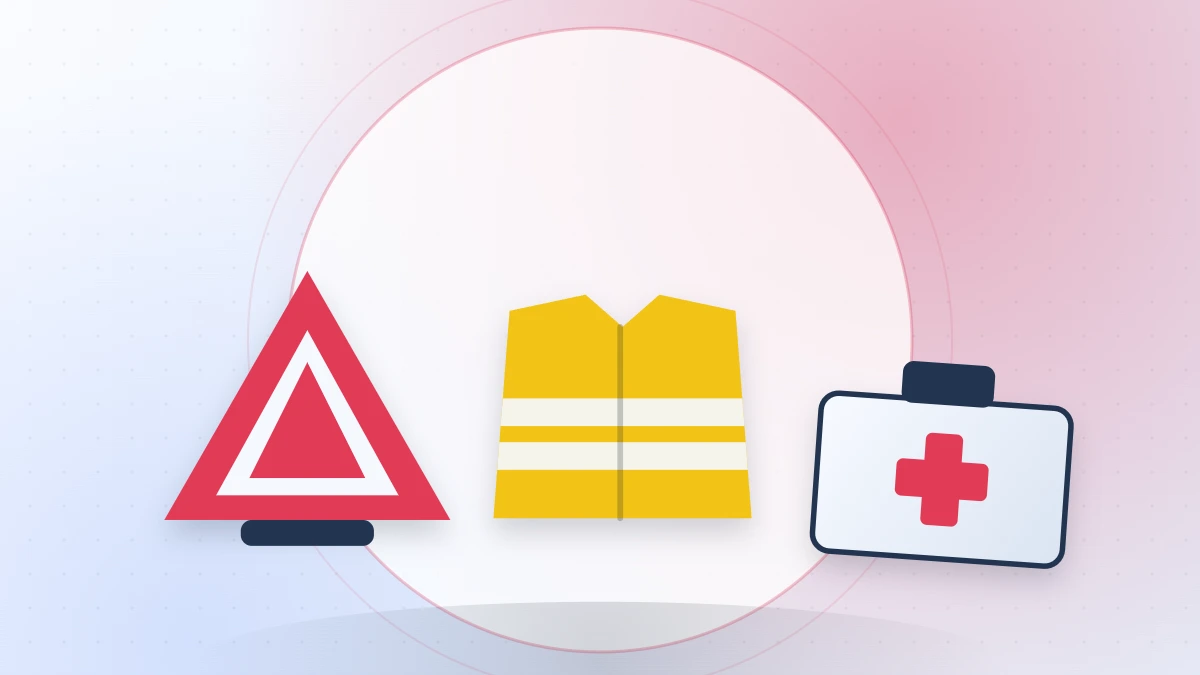
There is no single European list. Each country sets its own requirements, they apply to visiting drivers as well as residents, and they are revised more often than most drivers realise. What follows is the shape of the rules and how to check them properly — not a substitute for doing so.
Verify before you travel. Requirements change, and a list published in an article ages badly. Your motoring organisation and the destination country’s official road authority are the sources to trust. This section explains what to look for.
The items that appear most often
Across European countries, the same small set of items recurs in national regulations:
Warning triangle. The most widely required item of all. Some countries require two, particularly for vehicles with trailers. Cheap ones blow over; the specification to look for is an ECE R27 approval mark, which covers stability in wind.
High-visibility vest. Frequently required, and in several countries the requirement is specifically that it is reachable from the driver’s seat — not in the boot, which is exactly where a vest is useless if you have to get out on a motorway. Some countries expect one per occupant. Look for EN ISO 20471.
First-aid kit. Required in a number of countries, and some specify a national standard for the contents, such as the German DIN 13164. Kits have an expiry date on the sterile items; an out-of-date kit can count as non-compliant.
Spare bulbs, fire extinguisher, breathalyser. These appear in some national rules and not others, and several have been introduced and later dropped. This group is the one most likely to be out of date in any list you read.
What changes the answer
- Where the vehicle is registered. Some rules apply to locally registered cars only; many apply to all vehicles on the road.
- The vehicle type. Vans, trailers and vehicles over certain weights often face additional requirements.
- The season. Winter tyre or snow chain obligations are date-based or condition-based depending on the country, and are the most commonly missed requirement of all.
- Local restrictions. Low-emission zones, tunnel rules and city access schemes are separate from equipment rules and carry their own penalties.
How to check properly, in about ten minutes
- Start with your own motoring organisation’s country guide. They maintain these and have a reason to keep them current.
- Cross-check against the destination country’s official road safety or transport authority.
- Check each country you pass through, not just the destination. A transit country’s rules apply while you are in it.
- Check within a few weeks of travelling, not months ahead.
- Note anything seasonal separately, especially winter equipment dates.
The kit that satisfies most of Europe
Assembling to the stricter end of the range costs little and removes the research burden for ordinary trips:
- Two approved warning triangles.
- One high-visibility vest per seat, stored in the cabin, not the boot.
- An in-date first-aid kit built to a recognised national standard.
- A working torch.
- Spare bulbs if your car uses conventional bulbs and they are user-replaceable.
That covers the common requirements without needing a decision for each border. It does not cover seasonal tyre obligations, which are separate and enforced.
What actually matters at the roadside
Compliance and usefulness are different questions. The equipment that changes outcomes in a real breakdown is a vest you can reach before opening the door, a triangle you can place far enough back, a torch that works, and a charged phone. Everything else on the list is worth carrying, but those four are the ones that matter in the first sixty seconds.
*Requirements described here are general patterns, not legal advice, and are subject to change. Confirm current rules with official sources before each journey.*