
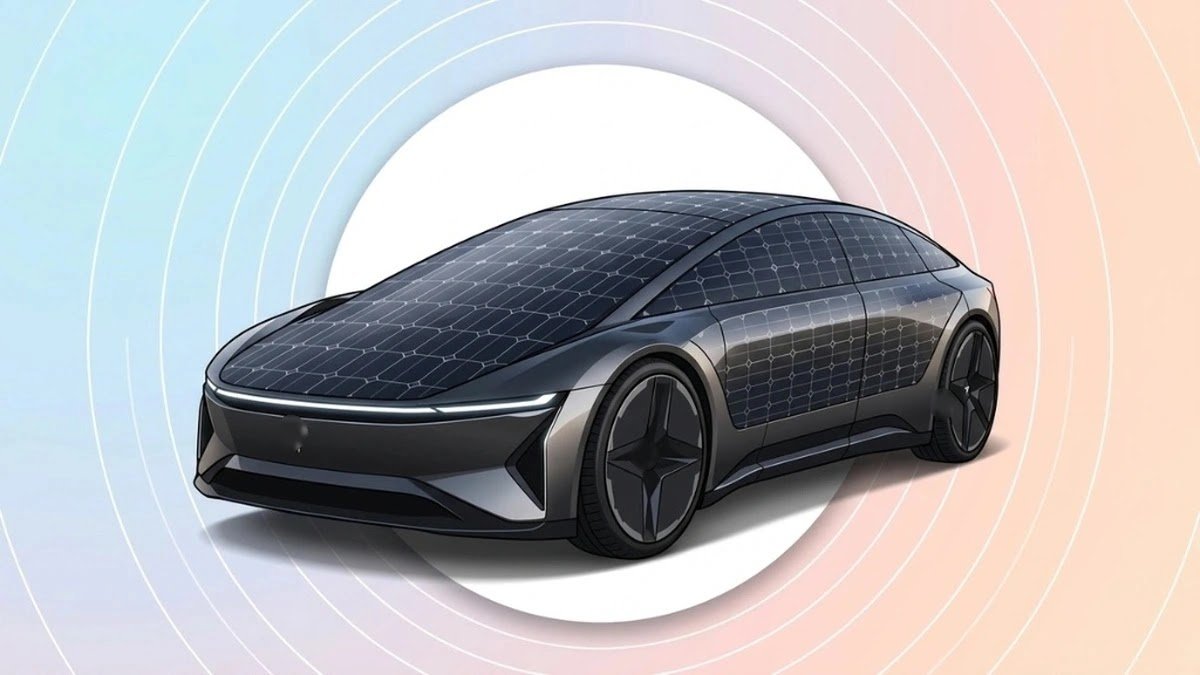
The pitch is irresistible: a film on your windows that looks like ordinary tint, passes visible light, harvests the ultraviolet and infrared you cannot see anyway, and quietly tops up your battery while the car sits in a car park.
The science is real. The arithmetic is where it gets uncomfortable.
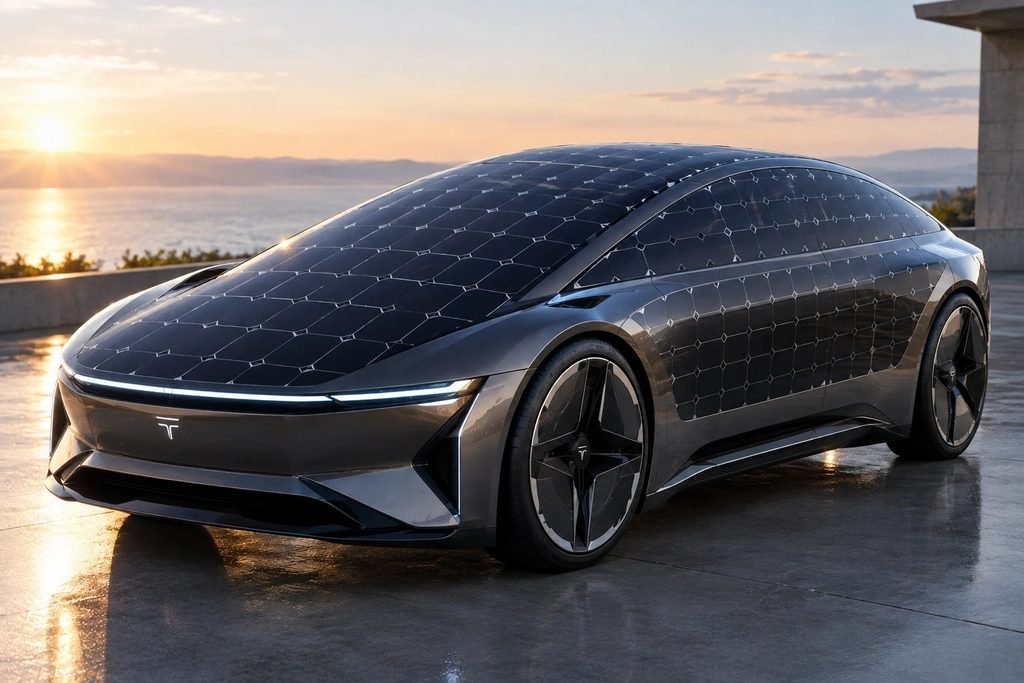
What has actually been achieved
The reference result comes from a University of Michigan team led by Stephen Forrest. Using organic cells tuned to absorb near-infrared while passing visible light, they reported 8.1% efficiency at 43.3% transparency in a colour-neutral version, and 10.8% at 45.8% transparency with a silver electrode that leaves a greenish tint.
Read those pairs carefully. 43 to 46 per cent transparency is not transparent — that is roughly the darkness of a heavy tint. The figure that describes a genuinely see-through cell is what the researchers call light utilisation efficiency, and there it was 3.5% and 5%.
On the commercial side, Ubiquitous Energy claimed a certified 9.8% back in 2019. The whole field sits in organic photovoltaics, which occupies the lowest efficiency band of any material system tracked by NREL — which has no “transparent solar” category at all — and global organic-PV production capacity is measured in a few megawatts.
Now put it on a car
Be generous with every assumption. Say two square metres of side and rear glass. Peak sunlight is about 1,000 watts per square metre. At 5% light utilisation efficiency that is 100 watts — at perfect noon sun hitting the glass square on.
Except car side glass is near-vertical, curved, and pointed in whatever direction you happened to park. Call it four decent hours a day and you land somewhere around 0.2 to 0.4 kWh. An electric car uses 15 to 20 kWh per 100 km.
That is one to two kilometres of range per day. Enough to offset the energy the car loses sitting still, and not much else.
The reality check that settles it
Hyundai already sells the opposite experiment. The Sonata Hybrid’s solar roof is opaque silicon — far more efficient than any transparent cell, mounted horizontally, in the best orientation a car offers. Hyundai’s claim for it was about 1,300 km of driving a year, or roughly 3.6 km a day.
A transparent film on vertical glass is working with less efficient cells at a worse angle. It cannot beat the roof panel. It will deliver a fraction of what is already a modest number.
What it is genuinely good for
Here is the turn, and it is a real one.
The way these films work is by absorbing near-infrared — which is precisely what a good ceramic window film already does, and precisely what makes a parked car an oven. Keeping cabin temperature down cuts the air-conditioning load when you get back in, and on a hot day that saving is almost certainly larger than the electricity the film generated.
So the honest description of solar tint is not “charge your car from the sun”. It is heat-rejecting tint that also trickles a little current — doing its main job the way tint always has, with a small bonus attached.
Judge it on that when it reaches the market. If it blocks heat as well as a good ceramic film at a comparable price, it is worth buying. If it costs three times as much because of the electricity, the kilometres will not pay you back.