
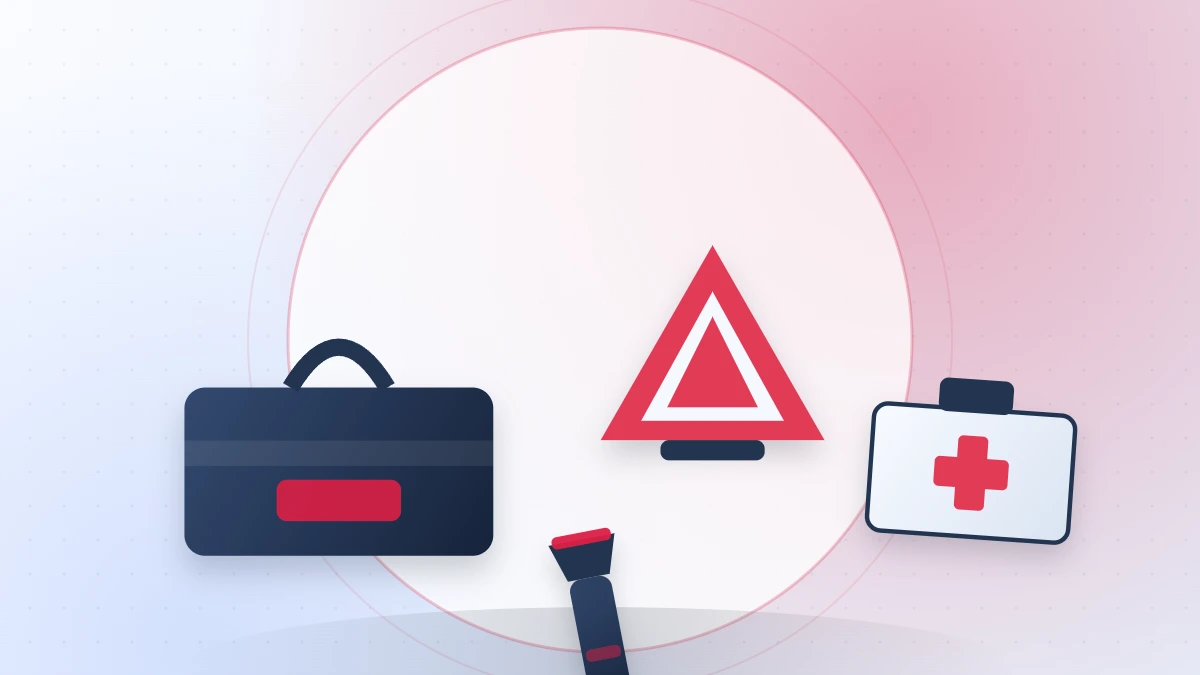
Pre-packed emergency kits are sold on quantity — ninety pieces, a hundred and twenty pieces. Most of those pieces are plasters. The kit that actually helps is smaller, chosen deliberately, and reviewed twice a year.
Start with what actually goes wrong
Ordinary breakdowns cluster tightly. In rough order of frequency: a flat battery, a puncture, a light or wiper failure, running out of screenwash in winter, and being stationary somewhere cold or dark for longer than expected.
Build for those, in that order, and you will have covered the overwhelming majority of real events.
The core kit
Visibility and protection
- High-visibility vest, stored in the cabin where you can put it on before opening the door.
- Approved warning triangle.
- A torch that works. Head torches free both hands and are far better beside a wheel.
Getting moving again
- A jump starter, charged, or jump leads if you prefer to rely on another car.
- A tyre plug kit and compressor, or a working spare with the jack, brace and locking wheel nut key present.
- Gloves. Every roadside job is filthy.
Comfort while waiting
- A foil blanket per seat, and in winter a real blanket.
- Water and something to eat that survives a hot boot.
- A charged power bank, because a phone at four per cent is the most common secondary problem.
Repairs and odds
- Cable ties and self-amalgamating tape, which fix more roadside problems than any tool.
- A multi-tool.
- Screenwash concentrate rated for winter temperatures.
Documents
- Insurance and recovery details, on paper as well as on the phone.
That is a single medium box, not a boot full.
The parts with a shelf life
This is where most kits quietly fail. Put a reminder in your calendar twice a year and check:
- First-aid kit — sterile items carry expiry dates.
- Tyre sealant — typically four to eight years, and useless once dried.
- Jump starter — lithium packs self-discharge. Recharge every three to six months. A pack left over winter is often flat.
- Power bank — same problem.
- Water and food — replace before summer.
- Screenwash — a summer mix freezes and can crack the reservoir.
A kit that has never been opened is not ready; it is untested.
Seasonal additions
Winter: an ice scraper that is not a credit card, de-icer, a folding shovel if you drive rural roads, extra warm layers, and grip aids. Check whether winter tyres or chains are legally required where you drive.
Summer: more water than feels necessary, a sunshade, and awareness that lithium packs degrade fast in a hot boot — the glovebox is cooler.
The things people carry that rarely help
- Enormous first-aid kits dominated by plasters, when the useful items are a pressure dressing, a triangular bandage, gloves and shears.
- Cheap multi-piece tool sets, which are heavy and low quality. A small set of the sizes your car actually uses is better.
- Petrol cans, which are restricted in many places and rarely legal to carry full.
- Anything requiring strength you do not have. A jack you cannot operate is not equipment.
The final check
Once a year, take everything out and look at it. Does the torch work? Is the jump starter charged? Is the wheel nut key in the car? Can you actually reach the vest from the driver’s seat?
Ten minutes in daylight, in a driveway, is worth more than any amount of equipment you have never touched.
*General guidance only. In an emergency, contact the emergency services first.*
Everything in Safety & Emergency
- This $10 Keychain Could Save Your Life — But Not in 1 in 3 Cars
- Element E50: A 230-Gram Fire Extinguisher With No Pressure and No Expiry Date
- What European Countries Require You to Carry in Your Car
- Emergency Window Breakers and Belt Cutters: Which Types Work
- Jump Starters with Built-In Power Banks: A Practical Buying Guide
- See the full Safety & Emergency archive